Showing posts with label Alternative Spring Break. Show all posts

Friday, March 4, 2011

Brevity III.

No home, but a boat, no longer afloat, on an otherwise empty lot.
poseidon, enraged
The city disappeared
in spinning ghosts of wind;
half, never to re-emerge
from under Poseidon’s trident.

A softer whisper
carries the mournful cry
of brass,
still strong in its sadness.

Yet now, the ghosts seep still
from the crevices
of lonely, misshapen timber
of homes
since forgotten.

Saturday, February 26, 2011

Nacho Regular Reflection.

A week of teamwork turned this lumber into something tangible.
New Orleans, LA – “I’ve ministered all over the world – from Africa to Haiti – but in a minute, the third world came to us,” said Pastor Randy Millet of the immediate and continued devastation of his city.

As ever, his eloquence was spellbinding. In a paean to seize the moment and create change, Pastor Randy spoke of how we generate snapshots in time in our lives and that he hoped our experience in New Orleans had become one for us. Heads nodded in unison. With that, he urged us to take the lessons we had learned home with us, to become successful and to remember to continue to give back to – and build – our communities. More nods of promise.

Despite the obvious nature religion plays in the Pastor’s life and words, the lessons he imparted perfectly encapsulated ASB’s objectives of learning from the communities in which we are working, incorporating this knowledge into our own lives and sharing it with others.

Having bid a fond farewell to Pastor Randy, we continued with ‘Nacho Normal Reflection™’ – our final team reflection session, led by Tyler and Katie, over a dinner of nachos for 40. Yes, that did, in fact, include eight pounds of ground beef, an equal amount of grated cheese and a dozen large bags of chips.

The mental commitment to reflection after hard days of physical labour has become one of this team’s hallmarks. Not only willing to share deep, personal emotions, team members have consistently offered extremely profound and thought-provoking observations that have generated emotion-filled conversations. There was no shortage of tears, reciprocal hugs, smiles and ponderous looks. It is obvious we have been tremendously affected by the people and devastation of New Orleans, and by the strength and friendship of our own teammates.

I feel extremely privileged to have experienced the bond and trust that formed so quickly with this team. That alone has been reflection worthy for me.

Now for 20 more hours on a bus, a return home and some tough goodbyes.

For now.

Music to our Ears.

A jubilant team and homeowner on the last day.
New Orleans, LA – The strains of Brooks & Dunn’s “Proud of the House we Built” breathed poignantly across the worksite as we approached the 4 p.m. deadline on our last day. It was both fitting and serendipitous.

Not to mention emotional.

As with all week, we had pushed hard throughout the day, installing tin flashing onto the cinder blocks to prevent termite damage, and both building and installing the subfloor. As we toe-nailed boards into place, heads popped up through the framework like a whack-a-mole game at the carnival. The rhythmic drumming of hammers on wood blended with strikes on flashing that was reminiscent of steel drums in the Caribbean. It was music to our ears.

Adrenaline and energy had begun to flag after a long week of steady days spent lifting, hammering, mixing concrete and digging in the heavy heat of N’awlins, but we still had our eyes on one last target that would help illustrate our progress.

Walls.

So, with the country tune in our ears, we hefted two of the exterior walls we had built earlier in the week onto the freshly built floor and nailed them into place – wearily raising our arms in victory. With that, the homeowner, Joyce, began to cry. Her home at 4768 Flake Street was very much becoming a reality.

At the end of the day, it was but a small step in helping rebuild the city, but to Joyce – and to our team – it remains a very significant feat indeed.

Magic.

Friday, February 25, 2011

Brevity II.

Far too many homes lay empty like this one.
in frame
Piles of photographs of homes
erased from lots,
lonely,
lying fallow beside
shattered shelter
formerly

what brought photographs
to life
and life to photographs.


the cross
Leaning houses, tattooed
like genocide survivors,
a constant reminder
with every cross
of the threshold.

The cross lays crooked
on the living room wall,
worn brown and faded
like the vibrancy
that once lived here.

Stilled, but smiling,
Steeled, but rising.

Thursday, February 24, 2011

Cementing a Reputation.

The new house is being built beside and abandoned one.
New Orleans, LA – As we raised pillars of cinder blocks – which came to be named ‘Cindy’ by many of our crew – the bubble in the level danced animatedly.

All the while, the incessant, high-pitched beep of the laser level chided us for having too much or too little mortar in our stacks of five blocks. After the first, third, fourth and fifth, we would beckon the measuring team – “Major Laser!” – who would carefully scrutinize our ability to spackle mortar between the heavy blocks.

Add or subtract, mix mortar and repeat. This house must be level.

After several days of heavy lifting and the repetitive motion of hammering, today was an exercise in precision for many. For others, there was still the thankless, but necessary, task of digging out the wooden framework that had been used to form the foundation.

While Habitat for Humanity has not traditionally built foundations themselves in this area – opting instead to hire contractors – they have begun to do so to save costs for homeowners and themselves. This, in turn, allows them to build yet more homes. At the end of the day, that is, of course, the whole point.

Despite having had a short day that ended at 2:30 p.m., we became the first group this chapter of Habitat has had complete all of the house’s pillars – which will hopefully minimize damage in the event of another flood – in one day.

Our reputation with the Habitat team was solid before, but really cemented with our effort today. *Groan*. (Yes, it has been a week of construction-related puns and jokes.)

Wednesday, February 23, 2011

A Strong Foundation.

Tyler makes the sparks fly, cutting rebar.
New Orleans, LA - Building, day two: More lumber, more lumbering across the lot with materials in hand. More hammering, more door frames, more excellent energy - paired with improved tool skills.

More cowbell.

But then, the day changed as the concrete truck arrived and unfurled like a praying mantis, breathing life into the house's foundation. Made smooth, we had built the base of not only a house, but someone's home and, hopefully, a small piece of a new New Orleans.

Tuesday, February 22, 2011

Building Progress.

Marta's a cut above (saw that one coming).
New Orleans, LA – Since Hurricane Katrina five years ago, Habitat for Humanity has built more than 400 homes in NOLA. While significant, that number is but a drop in the bucket – so to speak – when you consider more than 80,000 were destroyed by the storm.

It was with this sobering message we excitedly began our service-learning project today, pulling into an empty lot framed by abandoned homes that continue to shrug at the weight Katrina has imposed upon them. High-fives flew from fresh muscles, but only with a stark reminder of what has transpired here.

For nine hours, we created rebar frames to reinforce the foundation, lugged hundreds of pounds of lumber and materials, and hammered at nails that softened in the sweltering heat. We worked side-by-side with Margie, a homeowner at another location, and a pair of family members who were contributing to her sweat equity hours.

The Habitat program requires homeowners to contribute 350 hours of community service as a down payment – an effort that does not need to be directed toward their own home. This “hand-up, not a hand-out” approach also provides an interest-free mortgage on a house that is 80 per cent volunteer-built. While we remarked at how tired we were at the end of the day, we also thought of Margie, who still had an eight-hour shift to complete at her job when she had finished working with us.

Looking back at the sunburned team dwarfed by a tall stack of completed walls, I am convinced we will likely be one of those teams fortunate enough to actually see tangible progress at the end of our tenure here. Then again, this is a special team.

And a special city in which tangible progress is still very much in need.

Sunday, February 20, 2011

Parading Around the French Quarter.

One of the many street performers in the French Quarter.
New Orleans, LA - The morning fog that greeted us broke into cloying humidity as we set out to see some of New Orleans this afternoon.

First off, Pastor Randy directed a tour past some of the devastation from Hurricane Katrina. In St. Bernard's Parish, where we are staying, water levels had ranged from two feet to 28.5 feet. And it came in quickly, rising from a foot to nine feet in five minutes. Everywhere I go, I imagine or rather, try to 30 feet of water.

Now, empty lots rest as patchworks of dry greens and browns, framed by crippled fences bearing all-too-silent witness to a hurricane that completely destroyed the Parish. Five years later, broken windows still lean as though in a shattered mouth, doorways are shuttered and spray painted digits mark faded houses with a history that lingers still.

These derelict houses sit for sale, but unwanted: following the storm, the proud Parish's population dropped from 70-thousand people to 30.

Like the theatrical masks you so often see in boutique windows, however (grinning and sad alike), there are two sides to the city. Visiting the French Quarter, we were greeted by a vibrance and hospitality that belies the faded homes nearby.

Looking for the legendary Bourbon Street, half the team was suddenly swept into a parade. And, to paraphrase: "parades are awesome." Especially in the Big Easy. Carried away in a giddy sea of joy, we cheered, and were cheered, as the police car escorting the revelers blinked behind us.

Our fitting message from the City of New Orleans: seize the moment, because you never know what the next might entail.

Mardi Gras Meat.

'Team Lunch' and a cart-full of bread.
New Orleans, LA - Crossing from Mississippi into Louisiana, the road that never seemed to end dissolved into a ghost of fog.

On a bus for 22 hours through seven states and a province, we have set up camp at Adullam Christian Fellowship also known as City of Hope in New Orleans, preparing to spend the afternoon in the French Quarter. Spirits are high, and not just because we can hear the faint strains of Sunday service wafting through the air.

After a group meal at the International House of Pancakes, we broke into 'Team Breakfast' and 'Team Lunch,' invading the local Wal-Mart to gather supplies for the week. Three heads of lettuce, 24 loaves of bread, six gallons of milk and nearly 10 pounds of sandwich meat: the trappings of a few meals for 40.

Greeted by a thick accent matched only by his smile, the man behind the meat counter talked us up, and started teasing us by saying "eh" and "aboot." And asked of we had driven down through California.

Then he gave us free meat to celebrate Mardi Gras. Long live southern hospitality.

Brevity.

Rebirth, and destruction, side-by-side.
a relationship soured
Faded colours of a vibrant past
lie muted
and too tired to cry,
scribbled with exes
and numbers from a hissing can;
make-up, faded and smeared
framing windows of jagged teeth
punched in:
for sale,
but unwanted.

Eerie tombstones
of a history that didn't vanish
with the wind.

orphaned
Empty lots dressed with crippled fences,
palsied limbs
folded over themselves
as memorials to history;

Grey and green
for 40 miles
bear silent witness
to 29 feet of water
since seeped away,
leaving but memory
and memorials,
orphaned.

A sad horn cries in the distance.

Saturday, February 19, 2011

Hammer Time.

The road ahead is long for the Mustangs.
Jackson Centre, OH - Like a cement arrow pointing to the bayou, 20 hours of road unfurl before and behind us. Now a third of the way in: New Orleans, here we come.

Building on months of preparation and anticipation, the excitement of 39 Alternative Spring Breakers has seemingly been bottled into the bus like a soft drink, shaken vigorously. Soon, the building will become more tangible as we begin a Habitat for Humanity project in the Big Easy.

Despite some apprehension at the border as we waited to see if one of our team members would be turned back because of a misplaced passport, we were left with a relatively uneventful crossing. Exhale. A stunned jubilation took over from there, fueling this strangely exciting road trip.

With Ontario and Michigan behind us, Kentucky, Tennessee, Mississippi and Louisiana still loom lazily ahead. It turns out folding 6"3 into these seats comes as easily as sleeping in them. Which is to say, not.

Several hours in, the chatter persists. Cell biology texts lay strewn across upholstered seats, Shark Week has given way to the O.C. on the DVD player and a deck of cards shuffles between seats. Aces.

And the stale smell of french fries lingers still.

kentucky hills
The sun scorches behind
the scratched-out erasings
that carve jagged brushstrokes
folding over the curves
of these hills.

In darkness,
the lines shine brightly,
a second on,

a second off,
like a light switch
switched
hypnotically.

The beauty of not having to drive,
for once.

Sunday, May 9, 2010

Adios, Peru.

London, Ontario – After nine days, six flights, two trains and more than 12,000 kilometres over two continents, Team Esperanza has completed its service learning activities in Urubamba, Peru – three months later than anticipated.

It was the team’s second attempt, following February’s foiled foray that left us stymied at the border because of four inches of snow in Atlanta. If we hadn’t made it, we wouldn’t have had the tremendous opportunity to partner with two great organizations: Nexos Voluntarios and Villa Marcello school.

John wouldn’t have consumed 26 Inca Kolas, nor would Ellie and Cassandra F. have thrown back 10 litres of peach nectar – even posing with two boxes of it atop Waynapicchu’s 2,600-metre summit. Carling’s sunburned skin wouldn’t have thirsted for 250 millilitres of aloe vera cream and Sam wouldn’t have polished off one whole bottle of shoe shine on her dust-covered sneakers. Instead, Anisha and Alison – who proudly wore one sweatshirt every day of the trip – ended up doing two loads of laundry in a stream. (The shirt, however, did not take the plunge.)

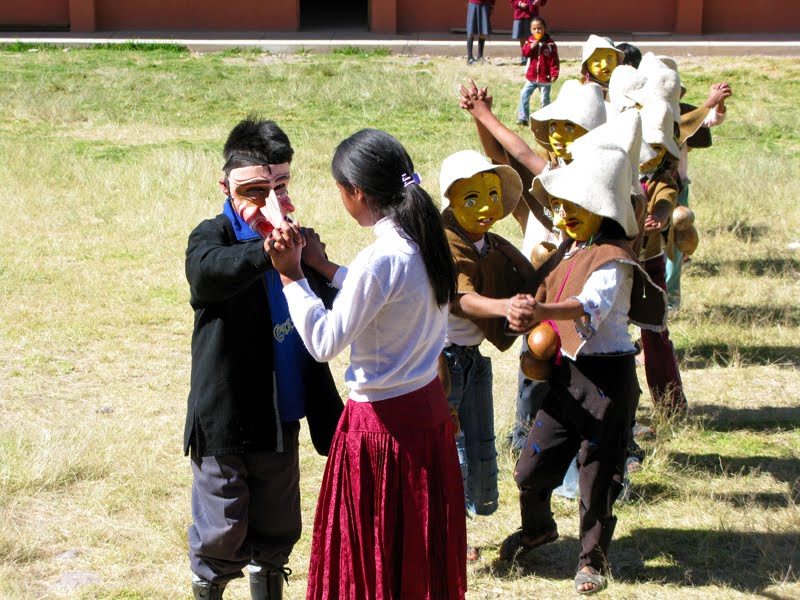
At NeVo House, Joanna prepared 100 brown bag lunches and Yoel once got away with using his ‘special defence’ as Jared hung him upside down. At Villa Marcello, Vivek and Mike finally celebrated a 2-1 victory in the daily lunchtime schoolyard futbol game – after three days trying. Then, basking in their glory, they realized they had beat a team of eight-year-olds. The school’s grade six class also put on one traditional Andean play, much to the delight of the Canadian visitors. Meanwhile, Nina led games of ‘pato, pato, ganzo’ (‘duck, duck, goose’), to many giggles.

The team completed the school’s second floor over four days, passing and lifting thousands of buckets of sand, gravel and cement for the one and only, Maestro. At one point, Doris caught a record seven buckets at a time; by the end, however, only three survived intact. During reflection, the team spent one night of stargazing in Maras, 3,200-metres above sea level. The experience left 20 mouths agape in wonder at the 360-degree panorama of mountains and countless tiny jewelled beacons in the sky.  

Esperanza’s members took roughly 10,000 pictures – led by Shannon, sporting two cameras, slung like six-shooters at her side. The blank pages of Jessie’s journal were also soon tattooed by more than 14 pages of memories – by the second day. At Machu Picchu, the team counted 13 llamas, including two babies. Of the team’s 20 members, 16 reached Waynapicchu’s summit at 2,634 metres above sea level in one hour, enduring thousands of steep, narrow Incan stairs, a dark cave and lungs and muscles that screamed endlessly. Zero bananas survived the trek, covering our bags and three sandwiches per person with sticky goo.

Cassandra C. led the charge in singing 12 consecutive Disney songs on the bus, which was designed to accommodate 18, but held 21. At the time, 16 were asleep and uneager to hear songs of any type. Two flimsy green plastic stools introduced to the van to get people off the floor fell apart in mere moments. Seven weight jokes were immediately directed at Douglas, under whom the plastic legs quivered. Looking for alternatives, four Esperanzites spent four Soles for one tiny moto-taxi – you do math.

Welcome to Peru: on the last day in Urubamba, several faces contorted in horror upon being presented with cuy – paws still attached. After six squeals from Jared, everyone knew just how cold a local shower could be; the whole week, there were only three warm showers total. And there were no clean clothes left. There were unlimited smiles shared and several colourful traditional blankets, bags and Inca Kola t-shirts purchased. Kelly’s potato chips expired in 1996 and there were zero times there was enough sleep. There were, however, many more friends and countless memories made.

With 20 hours of layovers, the team spent time playing five different card games, including euchre, which Deanna was just learning. There was also one impromptu game of hide-and-seek in Atlanta, and another in Lima where the team spent 56 minutes looking for Sunitha, who had asked nine people for help after passing the team, and the security checkpoint. None spoke English. Always in demand, Larissa was the team’s one member fluent in Spanish.  

Last roll call through letters A-T: “Start us off, Kelly.” 20 outstanding people and one phenomenal team: Esperanza, (Alternative) Alternative Spring Break 2010.
Thursday, May 6, 2010

Detour to Cusco.

Cusco, Peru – Last night, hemmed in by the serrated tips of mountains that surrounded us, tiny white lights danced in the blackness overhead.

The Milky Way seared a bright scar across the sky. In Maras, we had climbed to 3,200 metres above sea level for our nightly reflection session – but under the stars, away from ambient light.

Sporadically, comets arced across the tableau as many of the team layed on the on their backs, reflecting on the enormity of our world, and our universe. Unfortunately, the altitude took a grip on Jared and we needed to bring him into Cusco for medical attention.

In the middle of the night, the streets in the countryside were predominantly silent, except for large packs of dogs that would follow in the wake of our taillights. Bouncing down steep stone streets, I was impressed by the city’s massive churches and impressive plazas. Even in the darkness. The streets here, too, were quiet. And after a night’s rest, it’s hoped that what ailed Jared is too.

Wednesday, May 5, 2010

A Turn for the Worse.

Urubamba, Peru – What had otherwise been a great day suddenly took a turn for the worse for me this afternoon – literally.

Playing an impromptu game of futbol, I rolled my ankle, which left me writhing in pain as blood seeped from my hands and knees. Suddenly, the ‘glory’ of an earlier goal became insignificant as I wondered how I could continue to help the team on its last day of construction tomorrow, and hike Machu Picchu the next.

The morning began wonderfully, with the students performing a dress rehearsal of a historical play that teaches about poverty and terrorism in Peru. It was a pretty special experience, not to mention cute; however, watching nine-year-olds wearing yellow masks fall to the ground shaking their legs as though they were being shot was mildly disturbing – despite the historical accuracy.

All in all, it was an inspiring way to begin the day: after watching them, how could you not want to work on their school? And work we did, carrying more than 1,500 pounds of cement in 100-pound bags across the lawn and up to the roof. At 2,800 metres above sea level, it is easy to become winded.

Carrying, mixing and pouring left us covered in dust, which trailed us like puffs of smoke everytime we moved. Grey globs of dried cement clung to our legs. But, we finished one of the classroom floors and felt a tremendous accomplishment at what we had achieved in a few short days. One more day to go for Team Esperanza to leave its mark.

At the end of the day, we handed out donations we had brought for the students and walked many of them home, ambling hand-in-hand as we scattered throughout the village. Dogs and bulls pushed by, and citizens watched with curiosity. Common themes emerged from a number of these experiences, including the hospitality and graciousness of the children’s families, their desire to point out local plants and animals, and to ask questions about us.

Naturally, linguistic differences presented a few challenges, but the act of being together spoke more words than any of us could. Eagerly gathering back at Villa Marcelo as the sun set over the hills, we absorbed the warmth of another day full of experience.

Tuesday, May 4, 2010

Breakfast in Urubamba.

Urubamba, Peru – The sun seems to rise earlier here at the equator.

Wandering into the dining room at Nevo House, I am greeted by sunshine that gleams over the mountains, spilling onto the white walls and blue baseboards, warming the patterned tile floor below.

Looking out the short, narrow wooden doors toward the courtyard, idyllic pyramids of rock, brushed green, rise from the horizon in every direction. Three laminate-surfaced tables rest at the centre of the room, framed by wooden chairs, spaced around all sides to (tightly) accommodate the 20 members of our team. On the walls hang posters of popular destinations in Peru, a smattering of maps and correspondence and pictures from those who have formally lived and worked here.

At the centre of each table rests a plate with discs of bread, jam, margarine, a thermos of hot water for tea and a bowl of hard-boiled eggs. Spanish radio chirps from the kitchen and my nose dances to the aroma of lunch wafting out with the tune. Lost in the beauty of my surroundings as the sun kisses my skin, I am suddenly rousted from my reverie by an eye, peering around the corner.

Clutching a slice of tomato in one hand, year-old Danery, daughter of one of them women who works here, looks shyly, blinks and unleashes the largest smile possible, saying “dada.”

My morning is complete, and it has yet to begin.

Monday, May 3, 2010

Counting on Success.

Urubamba, Peru – With Alison leading the count of “Uno, dos, treis…cuarenta y cuatro, cuarenta y cinco…ciento cincuenta y dos,” the numbers rose, as did buckets filled with rocks.

Throughout the day, several hundred more loads of water, cement mix or clay bricks were passed, fireman style, along a line and up to the roof of the Villa Marcello school, where Team Esperanza has begun construction on a second storey – under the watchful eyes of Salbatore and the Maestro.

At various points, you may have found John or Doris swinging a pickaxe, or Larissa and Cassandra F. using a heavy iron mallet to drive a spike into the roof. In the process, they were roughing up the concrete enough to ensure the new cement floor will stick better.

Or, you may have encountered the long line of buckets being passed between Nina, Ellie, Anisha, Sam and Cassandra C., to Douglas, standing atop a school desk, and up to Jessie and Vivek, perched over the edge of the school’s roof. Sunitha created a sport for those returning the empty buckets, setting up a tire as a basketball net.

Looking down toward the school's tarmac soccer field, you may have found Jared, Mike and Deanna, perfecting the mix of cement and sand, their shovels glinting in the bright sunlight. Baking on the roof, Kelly smoothed out the mortar holding the new bricks in place.

During recess, children from all grades flooded into the courtyard and Carling and Shannon quickly recruited them into games of Frisbee, futbol and duck-duck-goose. Canadians and Peruvians alike lit up, fun activities superseding linguistic challenges. A smile is a smile anywhere.

And these smiles melted our hearts.

Younger children played games in a circle and posed for pictures holding their hands in the shape of a Western ‘W’, while girls in skirts vigorously bumped a volleyball and a spontaneous game of ASB vs. all-comers erupted on the soccer pitch. Weaving around us with ease and passing balls through our legs toward an awaiting header by a teammate, they beat us to nearly every ball – despite wearing burgundy wool sweaters and slacks in the 30-degree heat.

The whole while, the verdant mountains loomed majestically around us. It’s really no wonder Peruvians have so long tied nature to the gods. In reflection, 'Optimistic' and 'Excited' were key words describing the outlook for tomorrow. After today's complete team effort that was both tremendously fun and rewarding, it's easy to see why.

Sunday, May 2, 2010

Down to the Task at Hand.

Urubamba, Peru – Building on the day’s earlier theme of the sensory smorgasbord we have been presented with, we were greeted at the city market by vegetables of all colours, and spices of all scents.

The colourful blankets people wear blended right in.

A number of team members had wandered into the community after settling in to our three homes for the coming week. What better way to learn about a culture?

We later revisited the area on a guided tour that provided us with a more comprehensive overview of Urubamba. In the process, we also visited the merchant market, a couple of churches, the plaza and some Incan ruins. While it was nice – and no doubt helpful – to see the community in which we are going to be working, the team has been particularly vocal today about its excitement for becoming engaged with our service learning partner tomorrow.

And that, of course, is the whole point of being here, isn't it?

Coming to Senses on the Road to Urubamba.

Urubamba, Peru – Having flown from Lima early this morning, we drove by bus through the mountains to Urubamba, which provided everyone with an opportunity to absorb everything that surrounded us.

And there was much to absorb: from the smells of eucalyptus and diesel to the panache of colourfully dressed women sporting a variety of top hats, bowlers and cowboy hats – set atop long black braids that hung down their backs, tied together at the waist. 

From stray dogs loping through refuse piled in the gutter and dodging rocks thrown by an impatient man, to the persistent buzz of three-wheeled motorcycle taxis, there was so much to see, to smell, to feel.

Some absorbed the multi-coloured patchwork fields nestled into valleys punctuated by the jagged teeth of the glacier-tipped Andes. (Tufts of cloud appeared to nest atop many of the peaks like whipped cream.) Others were struck by the roughly constructed clay homes topped off by steel sheeting, or by mechanics trying to repair a rusted-out truck resting on the edge of a precipice.

Passing through stunning vista after stunning vista as we rounded hairpin turns with our luggage strapped to the roof of the bus, there was never any question of our surroundings attracting rapt attention – especially given that this was many team members' first experience in the developing world. 

Though dulled, all senses remained on alert – even with bleary eyes from the extent of travel and lack of sleep we have experienced over the past two days.

Yes, it really is that incredible here.

Lima Tender Moment Alone.

Lima, Peru – Tucked into niches between suitcases cobbled together like Incan ruins, several members of Team Esperanza lie under purloined airplane blankets, using the layover to catch up on sleep after a long day of travel. 

Though we have not yet seen any of it, we have arrived in Peru. 

At 5 a.m., we again take to the air, flying to Cusco before making our way to Urubamba by bus. Jared has draped his Canadian flag proudly at the entrance of our temporary Mustang commune on the second floor of Lima’s airport. Our distinctive purple Esperanza t-shirts are attracting curious looks from passersby. 

Shannon’s Western bandana provides a handy covering for some shut-eye. Perhaps best prepared of all, Carling lays cocooned inside a sleeping bag. Other team members poke at mysterious tropical fruit left for us in goodie bags by Nexos Voluntarios – the NGO with whom we will be working. 

Quaffing their first Inca Kola, still more convert dollars into soles. Others read, write or type. All the while, Enya is piped over the speakers in a continuous loop. Oh, Oronoco Flow. 

 Add all of this to the spontaneous games of hide-and-seek and cards that broke out in the terminal in Atlanta and you have an industrious team that can find ways to fill the time during our many layovers. 

But we’re here. 

And grateful to be.