Showing posts with label Children. Show all posts

Monday, September 26, 2016

Kudus and Kudon'ts.

Looking for something else.
Uis, Namibia – Topless Himba women, painted with butterfat and ochre, stand roadside – thick red dreadlocks falling from their heads.

Scattered amongst them, children with impish grins and loose checked blankets or loincloths scramble over a crooked tree branch. One sports a thin, closely cropped wedge of hair that courses over the centre of his head. A few conical and thatched huts lay conveniently behind tables of handicrafts.

Tourists flow from a line of trucks, shutters clicking at bare-bottomed children. Fifty Namibian dollars per photographer, please.

Billed as authentic, I can only imagine why, with countless miles of open space behind, we will pass several tiny villages at the side of the dusty highway. Uncomfortable with the spectacle being orchestrated I, and a few others, stay behind.

Privilege is very real. To me, it’s just too much of a human zoo: 'natives on parade.' This isn’t the way I wish to support the local economy.

To each their own, I suppose. I'll just watch the kudu and giraffes.

Sunday, September 18, 2016

On the Town.

Hamming it up for the camera.
Cape Town, SA – As we pulled into the township of Gugulethu, on the outskirts of Cape Town, a young man with a half-finished beer in his hand stumbled, tripped over his feet and fell to the ground.

When he stood, another man slapped him repeatedly on the head. Apparently, he was no longer welcome. He fell again. It was all of 9:30 a.m.

The township is home to 700,000 people living in tight quarters stitched together by scrap plywood, cardboard and sheet metal. Wood smoke from the braii clouds the air, and shreds of garbage bag flap in the breeze like Tibetan prayer flags.

Tellingly, countless crooked abortion posters are pasted to the outside walls, alongside murals advertising Coca-Cola and SIM cards.

While the community's people were lovely to us – and we were investing in their community – the experience felt precariously close to one of 'poverty porn.' It's a moment your privilege leaves you naked.

Even more, given the morning's first encounter, it seemed wrong to be on a tour where we were to learn how traditional beer is made, and then sample it. But we did, engaging in the ritual of doffing our caps, kneeling and tipping the large communal tin can to our lips. The bready mixture will win no awards.

Glassy-eyed men sat in the corner of the cramped black shack, egging us on.

We had made it to 10 a.m.

Tuesday, September 9, 2014

Ticket to Ride.

Hanoi's streets are a racquet.
Hanoi, Vietnam – The rains came down, and the ponchos flew up.

Yet, nothing stops the scooters – there’s cargo to transport across the city, and cell phones to be talked on as rush hour disintegrates into a puddle around us. Colourful fashion helmets like cricket players' bob by my window on the bus to BTL, as raincoats flap like capes: Hanoi’s modern-day caped crusaders.

I’ve settled into my routine of leaping onto a city bus at the last minute and bracing myself for the half-hour ride that weaves across a Red River stitched together by barges transporting sand from large scars on the river’s banks. I almost never get my $2,000VND in change, but don't care. It's the equivalent of a dime.

With each jolt in the road, the heavy plastic handgrips clack against each other like maracas. And the horns – ever the horns. Whereas taxis push bikes from the road, buses are the undisputed lions of these roads. And they aren’t afraid to growl.

Cornering the t-shirt market.
While I haven’t personally had any problems with the smog, quilted face masks are the other ubiquitous accessory in each corner of the city. Bright colours, plaids, Hello Kitty. Skull and crossbones.

A woman perched beside me on the bus had even hollowed out a baguette she used to cover her nose and mouth. This, despite having a more-traditional mask looped around her neck.

As we left downtown, the skyline offered a crooked grin as the mountains seeped through the morning fog. I had somehow previously not really noticed them smirking at me.

A quick cross of the road brought an exited shriek. Popping out of the doorway, a young girl chose to spend what is likely her only English word on me with a gap-toothed grin and a vigorous wave.

"Hello!"

There are precious few moments more tender.

Saturday, September 6, 2014

Hash Tag.

Holy crop, it's hot.
Hanoi, Vietnam – For an hour, we rode a rickety pink bus whose seats were so small I could taste the sweat brewing on my knees.

At 34 degrees with 82 per cent humidity, I had also begun to question my desire to take a hike in the countryside.

I had been invited on my first hash, having no idea what it was, or what to expect. Promised an opportunity to get out of town, meet people, get some exercise and have a few beers, though, I knew it was exactly why I had resisted the temptation to over-schedule my free time in Hanoi.

Hashing clubs have existed around the world since the 1930s, claiming to be "drinkers with running problems." From the link above:
Hashing is an exhilaratingly fun combination of running, orienteering, and partying, where bands of harriers and harriettes chase hares on eight-to-ten kilometer-long trails through town, country, and desert, all in search of exercise, camaraderie, and good times.”
Branching out and leaving people behind.
As part of the walking – rather than running – group, we followed our hare and searched for sporadically placed mounds of flour that marked our path – except where unimpressed locals had taken exception and washed them away. Almost immediately, we were diving through bamboo and banana leaves as we wiped sweat from our brows. Dragonflies helicoptered overhead.

We ended up in little villages and in rice paddies, where farmers with traditional conical hats huddled under faded umbrellas to tend to their crops.

Emerging near the Red River, cows huddled, nonplussed. The beer truck awaited, but we were more keen to simply melt ice all over ourselves – which did not take long. Moving on, friendly locals were surprised to see a group of foreigners traipsing through their gardens, and smiling children stuck their heads out of gates to practice their 'hellos.'

As we circled up at the end of the day, cups of beer were thrust into our hands to chants of "Down, down, down..."

The whole day – including transportation and unlimited beverages – cost 150,000 VND (about $7CDN), and was an excellent opportunity to experience things tour companies don't provide, and to meet a nice combination of locals and ex-pats.

From a personal experience standpoint, it's the highlight of my trip so far.

Wednesday, May 11, 2011

A New Goal.

DC and Titus, plotting World Cup dominance.
Chekalini, Kenya – Although I do not understand many words of their persistent chatter, the children here sound just like those anywhere else.

Excited. Eager. Proud.

In the blazing heat of midday, this chatter wilted as DC, Titus and I first kicked around a couple of guavas, then a ball crafted from rolled-up felt wrapped in a plastic bag and bound by twine. Games transcend the differences of culture and language that so often define our uniforms.

We laughed as we beat the ball into submission its felt unfurling like a tail and we flailed our legs wildly, attempting to communicate through the unspoken language of sport.

Taking my hand, Lincoln guided me the long way around the property to show me his school pointing out trees, flowers and other words he understood in English. With a kind smile, a funny face or an awkward dance, such differences in language can easily dissolve. In fact, sometimes language simply does not matter: some experiences are universal.

And no matter how one says it, I know I have been so tremendously blessed with my good fortune here.

Tuesday, May 10, 2011

Magic.

Titus, DC and Bobo during one of the welcoming dances.
Chekalini, Kenya – A long but beautiful day on the road has carried us to the most incredible of nights.

After wending our way over the clay arteries that lie beyond Eldoret, we arrived at Eric's family's home in Chekalini this evening. We were immediately greeted by a welcoming committee that framed the front of the house.

Eric dissolved into his mother's eagerly awaiting arms as we shook hands with his brothers and sisters, and high-fived the numerous nieces and nephews. There may have been a few tears.

We entered the house and were blessed with a traditional prayer of welcome and offered a meal. All day, the children had made excuses to stay home from school in case we arrived, conveniently forgetting their pencil cases or their homework. There may have been some excitement.

Initially, the children eyed the large white man I am with a degree of suspicion. Then I showed them just how poorly I dance.

Soon, they mimicked every shake of my arms and awkward rattle of my hips as everyone laughed and clapped along. Consider the ice broken. I soon taught them the 'exploding fist bump,' several new ways to contort one's face and "I've got my eye on you," replete with hand gestures.

They gobbled it up.

The children sang us songs in Kiswahili and English, and I showed Lincoln (Bobo) how to take photographs. He insisted on using the viewfinder, rather than the giant screen on the back. Whatever works. Then he and Titus reached up and took my hands to guide me on a tour of the property. It was pitch black, though the night sky was perforated with diamonds.

"Twende," they said as we wove through the dark pasture. There may not have been much we could actually see, but their pride in their home shone through.

Tonight was magical.

Wednesday, May 5, 2010

A Turn for the Worse.

Urubamba, Peru – What had otherwise been a great day suddenly took a turn for the worse for me this afternoon – literally.

Playing an impromptu game of futbol, I rolled my ankle, which left me writhing in pain as blood seeped from my hands and knees. Suddenly, the ‘glory’ of an earlier goal became insignificant as I wondered how I could continue to help the team on its last day of construction tomorrow, and hike Machu Picchu the next.

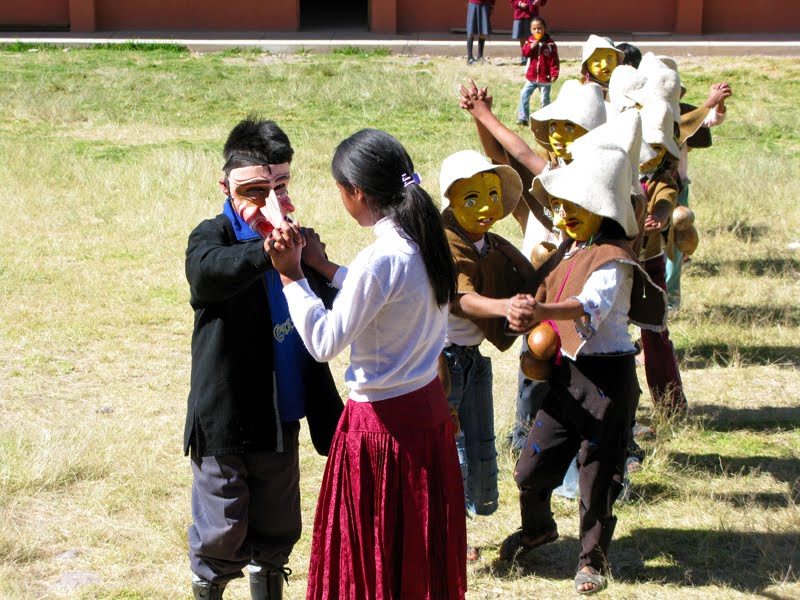
The morning began wonderfully, with the students performing a dress rehearsal of a historical play that teaches about poverty and terrorism in Peru. It was a pretty special experience, not to mention cute; however, watching nine-year-olds wearing yellow masks fall to the ground shaking their legs as though they were being shot was mildly disturbing – despite the historical accuracy.

All in all, it was an inspiring way to begin the day: after watching them, how could you not want to work on their school? And work we did, carrying more than 1,500 pounds of cement in 100-pound bags across the lawn and up to the roof. At 2,800 metres above sea level, it is easy to become winded.

Carrying, mixing and pouring left us covered in dust, which trailed us like puffs of smoke everytime we moved. Grey globs of dried cement clung to our legs. But, we finished one of the classroom floors and felt a tremendous accomplishment at what we had achieved in a few short days. One more day to go for Team Esperanza to leave its mark.

At the end of the day, we handed out donations we had brought for the students and walked many of them home, ambling hand-in-hand as we scattered throughout the village. Dogs and bulls pushed by, and citizens watched with curiosity. Common themes emerged from a number of these experiences, including the hospitality and graciousness of the children’s families, their desire to point out local plants and animals, and to ask questions about us.

Naturally, linguistic differences presented a few challenges, but the act of being together spoke more words than any of us could. Eagerly gathering back at Villa Marcelo as the sun set over the hills, we absorbed the warmth of another day full of experience.

Tuesday, May 4, 2010

Breakfast in Urubamba.

Urubamba, Peru – The sun seems to rise earlier here at the equator.

Wandering into the dining room at Nevo House, I am greeted by sunshine that gleams over the mountains, spilling onto the white walls and blue baseboards, warming the patterned tile floor below.

Looking out the short, narrow wooden doors toward the courtyard, idyllic pyramids of rock, brushed green, rise from the horizon in every direction. Three laminate-surfaced tables rest at the centre of the room, framed by wooden chairs, spaced around all sides to (tightly) accommodate the 20 members of our team. On the walls hang posters of popular destinations in Peru, a smattering of maps and correspondence and pictures from those who have formally lived and worked here.

At the centre of each table rests a plate with discs of bread, jam, margarine, a thermos of hot water for tea and a bowl of hard-boiled eggs. Spanish radio chirps from the kitchen and my nose dances to the aroma of lunch wafting out with the tune. Lost in the beauty of my surroundings as the sun kisses my skin, I am suddenly rousted from my reverie by an eye, peering around the corner.

Clutching a slice of tomato in one hand, year-old Danery, daughter of one of them women who works here, looks shyly, blinks and unleashes the largest smile possible, saying “dada.”

My morning is complete, and it has yet to begin.

Saturday, February 21, 2009

Day 41: An All White Affair.

Cyangugu, Rwanda – Between the preacher’s rapid-fire Kinyarwanda and the deafening din of driving rain against the church’s tin roof, I had little hope of understanding. But when the entire church turned in my direction with probing eyes, I knew something was up.

The bride was not the only one in white.

The preacher had said something to the effect of “We have a very well-attended wedding today – we even have a muzungu.” Having driven up a narrow hill being repaired by the community, it became obvious this village had not hosted many foreign visitors. It was said I was likely the first in Gihundwe Parish church.

Sitting to my left, Claude reached out and shook my hand, saying “Welcome to God’s church.” I learned then I was to acknowledge the congregation with a two-handed wave. To my right, children literally sat on top of each other on the edge of the pew opposite, trying to sit closer to the muzungu attending the wedding. The rest of the bench was empty.

I was honoured to join several colleagues from KCCEM for our colleague Laurent’s wedding today in Cyangugu. The new family had had their traditional wedding a couple weeks ago and now joined another couple being married in the church. I had never before seen two marriages conducted simultaneously.

In contrast with the overt joyousness of weddings in Canada, bride and groom were predominantly stoic during the ceremony. The young woman of the other couple even appeared frightened. Veils were lifted, but there was no kissing the bride. People clapped and said prayers, and hymns were sung. Vows and rings were exchanged and handycameramen manoeuvred around guests with a handheld spotlight. The same, yet different, and incredible.

Likewise, I found the reception fascinating and attempted to interpret the meanings of various ceremonial acts, which included a first meal and cutting of the cake (incongruously, as artificial snow was sprayed from a can). Again, the emcee made a point of sprinkling references to the muzungu in his monologue and looking in my direction with a big grin. A young child crawled off his mother’s lap and under the chairs, apparently disinterested with the occasion.

For me personally, it was an amazing cultural experience and I was deeply grateful for the invitation. I wish Laurent and his new bride the very best for their future together.

Wednesday, January 28, 2009

Day 17: An Evening in Kitabi.

Kitabi, Rwanda – The smoke of dinner’s cooking fires twists and curls up red hills, dancing with low-lying wisps of cloud like a woman in a loose veil. Together, they lower the blanket over the land.

Children use rough sticks to push plastic water bottles filled with sand down the hill – in the vastness of youthful imagination, everything is a toy. A group of children scampers into the hills – leaving a hand-made wooden scooter at my feet – after I surprise them by coming around the corner through the trees. 
 
Soon thereafter, they return, giggling. A large group follows behind, chattering in excitement. Once a timid girl in a colourful headscarf agrees to a high-five, a line queues behind her. The village is alive.

With no light pollution, the blackened sky curves like an iron pot and sparkles with a million pinpricks that allow the heavens to shine through.

Wednesday, January 14, 2009

No Words.

Gikorongo, Rwanda – I made friends with a few children in Gikorongo this afternoon while waiting for one of the team members who had gone into the bank. 

As a series of children huddled timidly around the truck, it became evident that, for the first time on this trip, my skin colour had made me an object of fascination. We made attempts at small talk in English, French and Kiswahili, but they seemed content to just stare at the “muzungu”.


Though we tried, my Kinyarwanda is still extremely limited and their grasp of English and French was limited to a few memorized questions. Responses, understandably, drew blank stares, or giggles. It became awkward rather quickly with little to say to each other, yet they remained on the other side of the truck window, staring in.

If only we had had a soccer ball.

Saturday, October 27, 2007

Day 13: A True African Experience.

Mwanza, Tanzania - As large raindrops begin to fall from a darkening sky, one of our host’s daughters reached up and silently took my hand in a sign of friendship as we made our way downhill through a small Mwanza community where we had had lunch. It was a sweet moment on a day that really featured a true experience in Africa that most tourists don’t have the opportunity to enjoy.

Meaghan, Alison and I had been invited to lunch by the interns’ housekeeper, Pendo, at her mother’s home a distance out of town. Making our way first to Pendo’s place, we were greeted by a succession of children – some hers (she has eight), some her sister’s and some her friend’s – in a small dark, teal room with a set of shuttered windows and a curtain that had been pulled across to separate bedroom from living room. Leaks in the ceiling were like large cup rings on a coffee table. Chairs and couches quickly filled as children came in, saying the respectful “shikamoo”. They seemed very excited to be having us as guests and quickly brought out a box of photographs and showed us their English homework. None of them spoke it much at all.

They were, however, quite eager to have their “picha” taken and would laugh with delight – and rib each other mercilessly – when we’d show them their facsimile selves on the backs of our cameras. The whole day, they’d point out photo opportunities and often stepped behind the shutter themselves. It was a nice change from having to be so careful about respecting cultural values here, where you don’t just randomly take pictures of people.

Eight children of various ages, the three of us and Pendo each piled into a dalla-dalla (a small mini-van-like bus) for the 25-minute ride to our destination. Stuffed beyond capacity, there were at times more than 25 sweaty people in the vehicle. And a basket of live chickens. This is Africa.

With the children leading the way and carrying a large basket of cooking bananas, vegetables, wood and other cooking supplies, we made the 20-minute trek up into the hills to Pendo’s mother’s home. The dirt ground in front of the relatively-large house was impeccably swept and out of small gardens sprouted plants that folded unto themselves when touched.

As one child flicked impat- iently though stations on a large radio, another showed off his dancehall moves; others began preparing the food and yet another box of photographs was brought out. The children eagerly pointed out themselves and their parents. Pendo’s mother brought out a large bag of plaited straw and taught the interns how to make intricate patterns that could eventually be woven together into large mats.

Lunch, made on a small portable stove outside, was cooking bananas with tomatoes and onion, and some pineapple. Sitting around a coffee table, the children eagerly dove into a large plate, using pieces of banana to scoop up the sauce. Apart from the great company and honour we felt at being invited, the amazing thing about this was that they fed 13 people – most of whom are still growing – for less than five dollars (the enormous bundle of bananas cost 3,000 TSH, or about $2.75). It boggles my mind.

After lunch, the children rose to action, whisking away the dishes, washing and cleaning the house while Pendo had her hair braided by her mother. This was all a real African experience and I was very thankful for having been able to participate in it.

Wednesday, October 24, 2007

Glasses: Half-Full.

Mwanza, Tanzania - All within five minutes today, we witnessed a large contrast of activities within the community where the interns’ apartment is located. Returning from the market, we saw a crowd forming as people hurried from all corners to see what the commotion was about. People were smiling, laughing and pointing toward a large throng of people amassed in front of a couple of stores, and someone else was lying on the ground. Suddenly, two police officers appeared from the centre of the mass, one firing shots into the sky, as they whisked an uncooperative suspect away. Yet five minutes later, when we came back outside, a crowd had formed for a different reason: some of the performers we had seen in the HIV/AIDS morality plays last week were doing an African dance, backed by musical instruments reminiscent of a southern jug band. Quite the activity – and a little surreal.

The heat hung heavily and we really felt its effects as we walked throughout the city, and over to the community kitchen, where Meaghan and Alison also teach the ‘yogurt mamas’ English three times a week. Today’s lesson was about the possessive forms of subjects and the interns worked with the mamas in both Swahili and English to help them understand proper sentence structure. The mamas were also really excited to receive reading glasses, which Meaghan’s mother had sent to the community. It was cute to see them trying on different frame styles, but the glasses should really benefit the mamas in their studies and day-to-day work.

All the while, a number of the community’s younger children began appearing on the kitchen’s steps and looked in at us with curiosity. Playing peek-a-boo and making some funny faces sent them into peels of laughter and led to their pretending to hide on the steps or to their scurrying away, only to return all over again.

Tuesday, October 23, 2007

Day Nine: Buswelu.

Mwanza, Tanzania - On roads carved from clay, and etched by rivulets and sinking tires, we made our way to the Buswelu Primary School this morning to take hand-made cards and picture books prepared in English and Swahili by students at Tecumseh Public School in London, Ontario for the children here.

At times, flooded roads became impassable and we were forced to wind through the labyrinthine community, past residents tending to meagre plots of land and washing clothes or themselves in their front yards. By the looks of surprise we received, it became immediately evident these weren’t roads regularly traveled by ‘s’. I suddenly felt very conspicuous and exposed in my pallor. The fact our cab ride to Buswelu – a suburb of Mwanza – cost an average man’s monthly salary was also food for thought.

Homes were generally constructed of clay or concrete; chickens, dogs and goats darted onto the roads with impunity. Children, of all ages, too. It continues to amaze me how many children are always scurrying about – often with loads of water or sticks on their heads – and taking care of themselves from very young ages. It’s not uncommon to see a five-year-old looking after his or her smaller siblings, without a parent in sight. I can’t imagine how young responsibility is foisted upon, or accepted by, youth here, but with the sheer level of poverty, there is an obvious reason why. There is very little time for parental supervision.

Upon arriving at the school, our car was immediately surrounded by children, pointing at us and asking us questions. Thankfully, Meaghan and Alison’s Swahili is much better than mine. Ushered into Headmaster Leonard Chinyele’s small office, we were welcomed and asked to sign the visitor’s register, which has happened everywhere we have been thus far. It was our hope to ask Mr. Chinyele to have students at the school write back to their Canadian counterparts on cards provided by the Western Heads East project; he readily agreed, saying that he could get them to us by the time the interns return home in December. The more we can learn about people in other parts of the world, the easier it can be to understand where we can help and what we can learn from them. Exposure to children like those at these schools is a positive first step.

Friday, October 19, 2007

Forever Angels.

Mwanza, Tanzania - Really making me miss my own back home, Meaghan, Alison and I spent the afternoon volunteering our time with the children at the Forever Angels orphanage in Mwanza.

The orphanage is currently home to 20 children under the age of three, and is being expanded to house double that number. Many of the children came from families where the parents died from disease, or were simply left on the orphanage’s doorstep. One boy we met had been beaten so badly, and left at the gate, that he needed to be resuscitated in hospital. Others had had their growth stunted by severe malnutrition. Most of them just wanted some love and some attention – just like any other child.

It was funny to see just how little difference there can be in children, regardless of where they are from – much like my previous experience, it seem inevitable that if you build a sandcastle, a child will get the biggest kick out of squashing it. And then asking, amid peels of laughter, to have it rebuilt. We played in the sandbox, gave piggyback rides, sat with the children during snack time, played catch and participated in other children’s games. One of the boys, Joseph, was really interested in my camera and wanted me to put Alison’s sunglasses on so that he could take a photo. Then, he wanted to take a picture of his friend. He was quite pleased with the results of his pressing the button releasing the shutter and capturing the moment for himself.

It was also a little funny to hear them sing the Bob the Builder theme song – or some variation thereof. Like kids everywhere, they’re good mimics.

Mabatini.

Mwanza, Tanzania - "Hapana, Asante"
(“No, thank you”) I said to the ‘yogurt mamas’ this morning after they expressed many thanks for our visit and for our support. “We teach you about probiotic yogurt, you teach us about life,” Gregor added. With the experiences we have had over the past week, such a statement resonated with a tremendous amount of poignancy. The energy the ‘yogurt mamas’ bring to the Western Heads East initiative and to their community is tremendous. I am privileged to have had the opportunity to witness this first-hand. We were meeting with the mamas for the last time as a full complement of team members on this trip; Gregor, Jennifer and Maryanne have just left for the airport. I, however, look forward to working with them again over the coming weeks before I, too, return home to Canada.

From a personal standpoint, I have been amazed to see the sheer number of children running about and looking shyly, excitedly or sometimes with trepidation, at these “muzungus” coming into their community in a Range Rover. The Mabatini village is not exactly a tourist destination. They are quick with smiles when you engage them, and are fascinated by seeing pictures of themselves on the back of a digital camera. Today, I nearly incited a mini riot of children who rapidly surrounded me after I took a photo of one of the boys and showed it to him. Soon, children – seemingly extricating themselves from crevices in the walls – clamoured around for their opportunity to be photographed and to be around the visitors. It was as though it took one to break the ice, to show we were friendly. The excitement is infectious. Of course, my handing out superballs to a few of the children only whipped the crowd into more of a frenzy, but you can’t possibly begin to bring enough for everyone. Children are, literally, everywhere.

This, of course, is one of the big reasons this project is so important. While I can presume it’s the same throughout the majority of Africa, I have seen first-hand, and know to be true, that malnutrition, disease and lack of access to potable water are ravaging populations in Kenya and Tanzania. It has been astounding to see so few senior citizens throughout our travels. I get a sinking feeling in my stomach when I realize just why that is: the average life expectancy is just 45. It’s universal whether you’re in Canada, the United States, Kenya or Tanzania: the children are the future. With this in common, we could certainly learn from each other to help create a better future around the globe. Despite their hardship, and often limited opportunity, the children here are, for the most part, extraordinarily happy. Many are sick, but they do not look defeated. Nearly all their clothes are in tatters, but “sawa” (“it’s alright”); it’s hot here.

It’s something I would suggest we think about a little more often as we stress about deadlines, bills and what shade of taupe to paint our walls. We certainly have poverty, disease and a different kind of malnutrition in North America, but here, it seeps into everything the dust can reach. Which is to say, everywhere.

Tuesday, October 16, 2007

Day Two: Oyugis/Kasipul/Kabondo.

Advance caveat: I'm aware this is far too long a post for a blog, but it was such an important day, I feel I had little choice. Given the inconsistency of Internet service here, it also comes relatively unedited.

Kisumu, Kenya - Put simply, this was one of the most incredible days of my life. While there is so much to say, I still feel trepidation in my fingers because words – especially in the written form – seem unable to do justice to all we did and experienced in such a short time. Without first-hand knowledge, much of rural Africa is, unfortunately, beyond the context of understanding for many North Americans.

Complaints about traffic and poor road conditions rank somewhere between hobby and sport in Canada, yet, I have never endured a ride bumpier than today’s trip past various villages into Oyugis, Kasipul, Kabondo and points between. The roads – where formal ones exist – are in serious states of disrepair, while others have been carved from the earth and wend their way awkwardly up hills and over jagged rocks. But it’s not that we could complain about traffic. The roads were nearly devoid of cars, though a few buses spewing black exhaust made things interesting on the narrow strips of pavement.

No, instead, the roads were lined with people walking or cycling, carrying with them their wares, belongings or other people – one bicycle transported five people. Along the way, children waved, smiled and ran alongside the truck; others led their goats and cows along the ditch. As we climbed into higher elevations, the relatively arid terrain gave way to lusher, tropical trees and plants, including coffee, pineapple and banana. Consistent throughout, though, was the poverty. The landscape was dotted by small villages of mud huts or tin-roofed shacks in varying states of disrepair, and by town markets teeming with activity and people hawking their wares.

Following a two-hour drive, our day began at the Rackuonyo District Hospital, where we met with the superintendent, the district AIDS/STI coordinator and representatives from KEMRI and the ministry of public health. The project’s researchers sought permission to include some of the hospital’s 5,000 HIV/AIDS patients in the probiotic yogurt project, a proposal agreeable to the superintendent, so long as privacy standards are maintained. Visiting the hospital was interesting in its own right as it was equipped with very few facilities – mostly an outcropping of small buildings the size of an average North American kitchen. Additionally, when we walked in, a technician was drawing blood from a long line of patients – without wearing gloves. This was mind boggling, particularly given the high-risk nature of the task.

We were then welcomed in the Kokal village by the Oranda Women’s Group, who will likely follow in the footsteps of the ‘yogurt mamas’ in Mwanza, Tanzania, and begin preparing probiotic yogurt for their community. “We are very happy for your visit,” the group’s chairperson stated as we were ushered to seats of honour in their compound as cows grazed and small children sucking on sugarcane peered with curiosity at their visitors. “This is the only project like this in all of Kenya, so you are leading the way for the country,” said Canadian scientist Gregor Reid.

We then made our way through villages to meet with the Nyanam Women’s Group, who showed great promise as advocates for the project and demonstrated particular strengths in communications, marketing and sales. “My argument has always been, who brings food, brings life,” added Isaac Luginaah, the project’s principal investigator. There could be real value in leveraging their aptitudes to help spread the word of benefits from probiotics and to potentially involve them with the sales aspect, rather than yogurt production itself.

For lunch, we stopped at a roadside restaurant and I enjoyed some local fare: fried chicken and a slab of ugali. While I came to Africa armed with 50-60 Swahili words, I have limited my use to fairly basic sayings, particularly “habari”, “nzuri” and “asante” (hello, I’m fine and thank you, respectively), but at lunch I used my first full sentence: “Samahaninaomba una chupa ye maji baridi; asante sana” (“Excuse me, I would like a cold bottle of water; thank you”).

In the afternoon, we met with two more groups of mamas to examine other viable options for community kitchens and were asked some important questions, including one about whether traditional, local sour milk products provide the same benefits as probiotic yogurt. Differences between controlled and uncontrolled fermentation are important to distinguish. According to Professor Reid, while the sour milk may provide certain benefits, bacteria in it dies in the gut and, thus, does not provide the same beneficial qualities as probiotics.

I am amazed by how ubiquitous Coca Cola is here. The company’s logo was permanently overlayed in the corner of a television program featuring music videos. Shiny red, well-painted bus shelters bear the Coke logo (and were unquestionably financed by them). In many villages, bright red Coke stands rise up between dilapidated shacks housing other businesses. And, in nearly all cases, the Coke buildings were the nicest ones in the village. Even more shockingly – and perhaps the irony of ironies – one of the hospital buildings was sponsored by the beverage maker (and bore a large mural to that effect). In a community with a 17 per cent HIV/AIDS infection rate, however, I suppose the hospital’s need for funding surpasses concern for diabetes, gum disease and other drawbacks of soda consumption.

For someone as interested as I am in the world and in how people live, today was an incredible opportunity to experience a different people, a different culture and a different way of life. It was amazing. Children would invariably bound along, waving and giggling or retreat shyly. Many would then soften with wide eyes and take off with peels of laughter with their friends. Replying “nzuri” to their timid hellos left them tickled pink. In matching school uniforms, they’d cut down the laneways and peer into the buildings we were in, often unsure until we waved or said hello. Then came the widest smiles. Driving through the countryside and villages, and meeting the mamas in the various communities was rewarding on so many levels.

This was a day to remember.
Monday, October 15, 2007

Day One: Kisumu.

Kisumu, Kenya - Now I feel like I’m in Africa. Having spent most of the past two days in airports and flying over the continent, I have arrived with the full team – which now includes Gregor Reid and his daughter Jennifer – in Kisumu, Kenya. Flying at the crack of dawn this morning, we were able to see Mount Kenya rising above a carpet of clouds – towering over it, in fact.

At Kisumu’s small airport, we were greeted by a group of uniformed school children who waved eagerly as we disembarked. Kisumu isn’t really a tourist spot, but the group seemed to enjoy watching the planes land. It’s a rural area, replete with farms and thatched houses on the opposite side of Lake Victoria from Mwanza, Tanzania, where we are headed in a few days. In town, however, Kisumu is pretty hectic, with Jeepneys and bicycle taxis careening down the roads and through the myriad roundabouts. In reference to driving in Kenya, our driver this morning said, “Here, you just take care of yourself”.

Gregor and Jennifer have already been on safari, and also had the opportunity to get up-close and personal with some cheetahs, and to pet them (apparently, they purred). Wild giraffes also come up to their hotel’s windows, and stick their heads through, which, based on the photographs, looked pretty neat. So far, I’ve only seen some pelicans or storks, and a crane, all of which are really large birds.

As the Internet service has been down at our hotel for a few days, we sought out an Internet café, which turned out to be a bit of an exercise in futility. After playing musical chairs trying to find a computer that would even let us open a web page, we waited. And we waited. Then, a couple of us drafted quick emails and pressed send. Nothing. The service went down and our efforts were lost. While we got nothing in return, all things considered, the 17 Kenyan Shillings I spent amounted to less than a Canadian dollar for a half-hour of so-called connection. And, I like to think that’s part of the experience, too.

As I am want to do, I parted from the group for a while this afternoon when we had some free time. I wandered outside the city gates and came across a large open market, where they sell pretty much everything, from dried fish, to fresh produce, to clothing. I tend to like to immerse myself in the world I am visiting, and not just visit tourist sites. I like to see how people live and what locals do and, because of this, I can be a bit impulsive in my wandering. Based on some of the looks I received, I’m not so sure I was welcome in this market. Being such a shutterbug at home, I also had to be more careful, given that many people here don’t like to have their photos taken, or want to be paid if you do. I encountered one vendor who asked me to pay up, though I hadn’t even been shooting in her direction. I also acquired a shadow, a young boy named Ricky, who followed me back to the hotel, asking for money, keeping up by hopping along on-and-off of the ragged sidewalks.

Our plans have changed for today and we will now not be going to Oyugis until tomorrow morning, but we have meetings for the rest of the afternoon, and into the evening.