Showing posts with label Climate. Show all posts

Friday, July 7, 2023

Ice Landing.

Un-wolf-like lupines.
Reykjavik, Iceland – The North Atlantic recedes into moonscape as we descend with a bump into Keflavik.

A church, nestled neatly into the shore, blends into an outcropping of rocks, its steeple the only pin in an apparent plan for stealth. Old tombstones are scattered around like pebbles.

The ground nearby is a wrinkled camouflage shirt of muted greens and browns spattered by purple tufts of lupines.

Riding the Flybus Airport Transfer into Reykjavik, which is 45 minutes away, appears to be the most cost-effective option, unless you’re already renting a car.

It’s a smooth ride past a tight green thread tucked into black, where golfers swing through a few holes. The volcanic rock no doubt offers many more.

Winding through a town, we pass brightly painted homes clad in steel, before tracing the olive green ribs of mountains illuminated by a sun that only sets for three hours these days.

It’s hazy, not unlike me this morning.

And I’ve had even less rest.

Friday, June 7, 2019

I, For One, Welcome Our New Robot Overlords.

Forest of the future.
Singapore — In a garden of glass, a garden.

We have spent the afternoon wandering down to the Marina Bay Sands Hotel — with its ship for a hat — and into the adjacent Gardens by the Bay, from which sprout futuristic-looking Supertrees.

The 50-metre-high solar-powered structures function as vertical gardens, collecting rainwater and venting air. More than 158,000 plants contribute to a living painting on the surfaces of the 18 Supertrees found throughout the park.

At first glance, though, it looks like we've been invaded by giant, wine glass-shaped robots.

That could have its advantages.

Behind them, giant glass beans arc from the gardens. One hosts the Flower Dome — the world's largest glass greenhouse — and its ever-changing horticultural displays from around the world. It's a garden in a bottle.

I'm half expecting a bungee jumper.
The other is home to the Cloud Forest, which replicates cool, moist conditions found in tropical mountain regions. It claims to have the world's tallest indoor waterfall.

But, as of a couple months ago, it's no longer even the tallest in this tiny country. That distinction goes to the newly constructed, 130-foot-tall Rain Vortex at Changi Airport.

Which doesn't mean it's any less impressive. A mane of tropical plants and flowers punctuate the 35-metre mountain set at the facility's apex. The climate offers respite from the swelling heat being kept at bay beyond the building's dizzying array of angles.

I can't help but think I'm stepping into the plant zoo of the future — one that harbours the last remaining species not yet lost to climate change or habitat destruction. Despite the facilities' efforts to increase awareness of sustainability, it strikes me as an apt metaphor. The irony is not lost on me that these gardens are indoors.

Alas, as we wind through each of the facilities, people, one by one, take time not to smell the roses, but to arrange them as backdrops for Instagram selfies.

My imagined dystopia may not be far off.
Friday, May 31, 2019

Peaking Doug.

Just a peek.
Victoria Peak, Hong Kong – The day’s journey begins as a slalom between cheap umbrellas spitting the morning’s weather onto my face. It’s a rushed blur of colour set against the mist.

At my height, it’s also a risk to the eyes.

Incense and pungent dried herbs paint colourful scenes as shop owners toss cardboard and styrofoam boxes into the road while setting up for the day. Streetside butchers bathed in bright lights cleave their wares to barked orders.

As we make our way up steep, bamboo-lined hills toward Victoria Peak, cicadas scream like small saws from moss-covered trees. With each step, skyscrapers fall into the sea behind us.

I pity the Foo (Dog).
Our lungs fill with clouds as we make our way up the 2,800-metre trail to the summit. All the while, the humidity reminds us of our humanity. Butterflies with jewelled wings flutter by like ballet-dancing broaches. A flautist, out for  a stroll, sets the scene as our sweat nurtures the soil.

The hike has taken us close to an hour in the rain, the start of which was quite steep, before settling in for an even, circuitous trail.

As the skies finally open up, though, so do the views, glass stalagmites rising into the rainforest.

It's why we made the trek.

Thursday, May 30, 2019

Nature Versus Nurture.

We've been building to this.
Sai Ying Pun, Hong Kong – Lush, green hills hooded in rain clouds unfold beside us. They’d be more lush without several layers of weathered vellum laid over them.

The phallic machismo of shipping cranes and industrial steel, meanwhile, thrust from the water on the other side. Again, I question progress in the face of scarred beauty.

With a smooth purr, however, the train ride from the airport into the city strikes a balance: past versus future; beauty versus enterprise. Sometimes it's just a matter of the side you choose to look at.

Our arrival is like velvet.

And yet, I’m unsure what’s foggier: the landscape, or my mind after a 15-hour flight that left at 1:30 a.m. old-local time.

At what point do daydreams evaporate into the clouds around us?

Wednesday, September 28, 2016

Water, Whole.

Etosha National Park, Namibia – The sun has set and the park has come alive. A low, baritone rumble issued below us serves as a warning.

A more forceful trumpet: a rebuke.

Elephants of all size – lit against the darkness – have gathered at our camp’s waterhole. Four rhinos, meanwhile, have infringed upon their space. One of the junior male pachyderms flaps his ears and mock-charges, causing three of the rhinos to retreat to a safe distance.

Another, unfazed, strides into the water. For a moment, an uneasy truce.

One of the many baby elephants, taking a break from suckling at its mother, grows curious, wandering over to the interloper. Its mother uses her trunk to forcefully flick water at the rhino. The message is clear.

A bunny hops by in the foreground between a pair of jackals, offering comedic relief.

The park is dry, but it won’t be long before humans, too, fight wars over water.

With more than 50 elephants now ringing the pool, the rhino snorts and shrugs, shuffling back into the bush.

Crisis averted – the calf, trying to catch up to its trunk, remains blissfully unaware of the high alert its curiosity has caused.

Thursday, September 22, 2016

Sands of Time.

Say, do you come here often?
Sesriem, Namibia – We queued along the crease between light and dark as the sun mounted its assault on the sky.

We had arrived early to climb Dune 45 – purported to be the second-tallest dune in the world, behind nearby Dune 7 – in Namib-Naukluft National Park. Looking around later, doubt in that statistic crept in like the shadows that fell onto each of the sand's curves.

Sometimes you have to take these 'facts' with a grain of sand. Still, the dune is 80-metres high, and composed five-million-year-old sand.

Either way, it was hilly beach as far as you could see. The sand was soft and cool on the feet, but each step forward led me to sink anew as we hiked the knife-edge to the summit. Soon, my legs themselves felt like sand. I had become one with the mountain.

The hourglass, filled on the way up, emptied in an instant as I promptly ran straight back down.

As the temperature climbed, we carried-on to Sossuvlei, making our way to a 400,000-year-old dried lake bed now carpeted by bleached clay. The gnarled remains of blackened trees twisted hauntingly from cracks in the ground that mirrored their grotesque – yet beautiful – form.

History, preserved; the hourglass tipped for another day.

Wednesday, September 21, 2016

Somewhere.

I'm rooting for the defiant tree.

Sesriem, Namibia – An evening cold had dropped into the desert, but the rising sun warns menacingly of its impending bite.

Knowingly, a springbok grazes on the hill, snacking before the heat becomes unbearable.

We spent the night at the Canon Roadhouse campgrounds near Fish River Canyon, which is the world's second-largest canyon at 156 kilometres long, 27 kilometres wide and 550 feet deep. As runner-up, it’s just as grand.

We're also making our way through the world's largest national park – Namib-Naukluft National Park – which will take three days.

Given the apparent absence of people – of life, period, frankly – it seems like it may also be the least-visited. A low fence has lined the entire route, but there hasn't appeared to be much to keep in, or out.

This has been middle-of-nowhere. Like, really middle-of-nowhere.

That has been part of the beauty of this trip thus far: watching the landscape dance between mountains and valleys, swirling from green, to red, to yellow, to brown, to grey; spying round tufts of scrub popping up like heads in the sand; and tracing the scars of desiccated streams. Even the water is too lively to linger long.

We are travelling over millennia of dust that twists and settles temporarily like an anxious nomad, muting the few plants to have the audacity to turn green. Rocks, sand, scrub. Repeat.

Even nowhere is somewhere, and in absence, beauty.

Lunch in a Namibian Desert.

Time for a sand-wich.
Somewhere, Namibia - Pulling off the dusty road, we tuck under an acacia tree dotted by spherical spiral weaver nests. Hills fade off into the distance.

A blanched jawbone rests next to a tic-tac-toe of snake holes. A persistent fly buzzes excitedly at the sudden appearance of life. Thankfully, the wind whips up, providing a natural fan to combat the sun.

Inexplicably, two horses cling to the side of a cliff. In the middle of nowhere, we have found some of Namibia’s wild horses, only 90-150 of which remain.

With improved efficiency, the group hauls tables, food, washing materials and chairs from the truck. The day's work crew prepares materials for a salad and sandwiches. We are quietly becoming accustomed to life as overlanders.

Roadside, somewhere in Namibia, lunch is served.

Amazing.

Tuesday, September 20, 2016

Can you Canoe?

Surf border-crossing.

Namaqualand, South Africa - The ride down was smoother than the one up.

It was also wetter.

Bouncing between powdery rocks on an ochre-hued mountain exhaling large clouds of dust, we made our way by van to the launch point upstream on the Orange River, which divides South Africa and Namibia. The door holding us in caught a breeze and flew open with a slam.

The glass had apparently previously cracked for a reason.

Dipping the paddles to our two-person inflatable canoe into the cool, brackish water, we casually made our way downstream, popping through small rapids. The sun welcomed us with fierce intensity. 

After more than two hours on the water, we radiated some of it back.

The river is the lone scar on an otherwise completely arid region. Fish somersaulted and egrets fanned their wings as we passed. Atop a lone, skinny tree perched crookedly on one of the many promontories sat a massive fish eagle, seemingly being picky about its next meal.

I cooled off with a quick dip: it's not every day you have the opportunity to swim between countries.

Monday, September 19, 2016

Interlude.


the hourglass – overland, south africa/namibia

Red hills roll by
between window frames
like film,
taking me forward
and back in time.

The plot is a slow burn,
but with the hours,
a denouement
where mountain faces
are scrubbed clean.

The sands of time
have emptied here.

2016.9.19


pole pole – overland, south africa/namibia

Dust that predates time,
clapped like chalkboard erasers
choking on the past.

Between rocks and sand,
scrub clings to an existence
at the table of
an unwelcoming host.

Its breaths, slow and dry
like the nature
of the millennias' worn-down rock
it is.

Patient boulders await
their day in the sun.

2016.9.19

Saturday, September 6, 2014

Hash Tag.

Holy crop, it's hot.
Hanoi, Vietnam – For an hour, we rode a rickety pink bus whose seats were so small I could taste the sweat brewing on my knees.

At 34 degrees with 82 per cent humidity, I had also begun to question my desire to take a hike in the countryside.

I had been invited on my first hash, having no idea what it was, or what to expect. Promised an opportunity to get out of town, meet people, get some exercise and have a few beers, though, I knew it was exactly why I had resisted the temptation to over-schedule my free time in Hanoi.

Hashing clubs have existed around the world since the 1930s, claiming to be "drinkers with running problems." From the link above:
Hashing is an exhilaratingly fun combination of running, orienteering, and partying, where bands of harriers and harriettes chase hares on eight-to-ten kilometer-long trails through town, country, and desert, all in search of exercise, camaraderie, and good times.”
Branching out and leaving people behind.
As part of the walking – rather than running – group, we followed our hare and searched for sporadically placed mounds of flour that marked our path – except where unimpressed locals had taken exception and washed them away. Almost immediately, we were diving through bamboo and banana leaves as we wiped sweat from our brows. Dragonflies helicoptered overhead.

We ended up in little villages and in rice paddies, where farmers with traditional conical hats huddled under faded umbrellas to tend to their crops.

Emerging near the Red River, cows huddled, nonplussed. The beer truck awaited, but we were more keen to simply melt ice all over ourselves – which did not take long. Moving on, friendly locals were surprised to see a group of foreigners traipsing through their gardens, and smiling children stuck their heads out of gates to practice their 'hellos.'

As we circled up at the end of the day, cups of beer were thrust into our hands to chants of "Down, down, down..."

The whole day – including transportation and unlimited beverages – cost 150,000 VND (about $7CDN), and was an excellent opportunity to experience things tour companies don't provide, and to meet a nice combination of locals and ex-pats.

From a personal experience standpoint, it's the highlight of my trip so far.

Friday, September 5, 2014

The Whole Song and Dance.

Team work, and Team not-so-work.
Hanoi, Vietnam – Before the day's heat drops like a hammer, women move silkily around Hanoi's broken sidewalks.

It’s an early morning ritual to practice tai chi under Vietnamese willow trees, which hang languidly around the lakes. Some believe they hold ghosts.

Riding a bus with shocks that feel like a bouncy castle, we coursed along the Red River to welcome a delegation from Seng Kang Secondary School in Singapore this morning. The ride cost .50 and took about a half hour as the courteous ticket taker directed riders to specific seats.

I was given the front, rather than the tiny red plastic stool placed in the middle of aisle. My aching knees thanked him.

The students put on some Singaporean songs and dance, and played in the courtyard with local students, tripping over each other in games designed to inspire a high level of teamwork. "Soft skills" has been a term I have heard repeatedly since arriving, including by the head teacher from Singapore: "Mastery of core skills is no longer sufficient," she said.

The rest of my day was spent scoping out my activities for the next few weeks with the ever-helpful Mr. Viet, and attempting to conduct a marketing scan of Bắc Thăng Long College's current and proposed activities. I have thus far had some difficulties locating strategy, as "things change quickly here."

And yet, in other ways, change does not, in fact, come quickly.

My first week, however, is complete.

Thursday, September 4, 2014

Fingers to Keys.

Who are you calling fat?
Hanoi, Vietnam – It was like having the weight of Hanoi’s looming humidity lifted when I finally got down to my mandate for the full day.

It’s not that I'm unappreciative of having the opportunity to see the city and to let some of the jet lag seep from my body, but I am here for a purpose. And time, frankly, is short.

So, it was with fingers a-flurry I filled the screen with pixels, preparing a draft of my work plan for the next few weeks and crafting a series of interview questions for Mr. Vinh so that I can begin to understand the College’s strategic direction, current marketing initiatives and potential opportunities.

While the unemployment rate in Hanoi is only two per cent, a significant majority of the population is underemployed and not working in their fields of study, which has led to needs for re-training. Colleges, however, suffer from an inferior reputation to universities, regardless of whether they provide direct leads to jobs.

It’s similar to many traditional views in Canada that have only recently begun to shift.

If felt good to work. The two-hour lunches with a leisurely trip to the café, however, still take a little getting used to.

But not as much as those drowned in rice wine.

Saturday, August 30, 2014

Buổi tối tốt Hanoi.

Local flavour.
Hanoi, Vietnam – Curling my eyes open, I am greeted by a thunderstorm that lights up the clouds like Chinese lanterns. Below, Shanghai glows orange against the darkness. Still more than an hour to go.

We land in Hanoi under a rusty scythe of a moon, and I am immediately embraced by the familiar leafy aroma of the tropics, and by the humidity, which clings to my every pore like a grieving widow.

The drive from the airport seems endless – so close now – taking well more than an hour to travel 25 kilometres into the city. The ground vibrates from the endless rows of scooters, carving new directions to find Saturday night. Red lights – where they have them – appear to be nothing more than decorative.

A young girl, clutching to her father's flapping windbreaker, wears no more head protection than a plastic tiara.

After 26 hours of travel, it is nice to see the smiling faces at Church Hotel, and even nicer to have dinner and a couple beers unexpectedly arrive in my room.

Let this experience begin.

Tuesday, May 10, 2011

Quite a Rift.

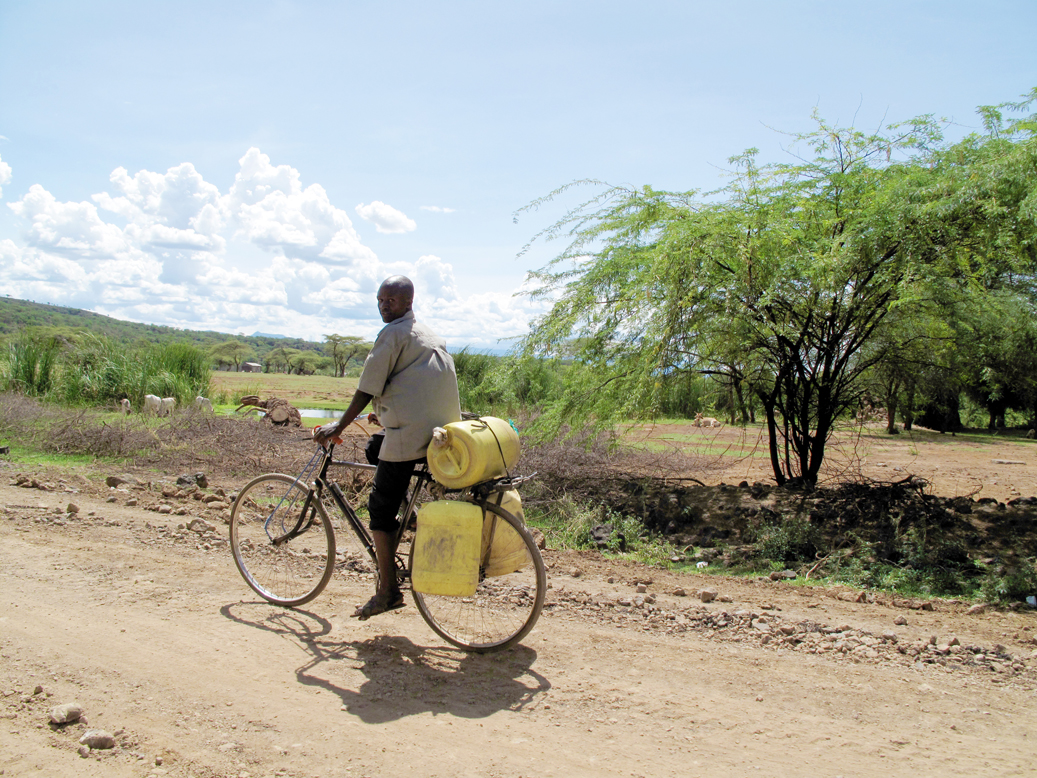
A man rides his bicycle through the Rift Valley.
Chekalini, Kenya – As we coursed along its tongue, the cavernous jaw of the Rift Valley appeared to swallow us, its pebbly walls rising as we wound down serpentine switchbacks into dry pastures of scrub and stretching acacia.

Cacti lined the road, standing sentinel with spiny paddles.

The road at the head of the valley, which leads to former President Daniel arap Moi's home region, is well-paved, but silent. As so few vehicles pass by, locals quip it is best known as a resting place for goats and cows.

Sure enough, around the corner lay a goat, nonplussed, chewing on a long blade of grass.

Crossing the equator and descending farther, however, we rattled across pocked roads as the ground blushed with the red of clay, its lips whispering small puffs of dust. Termite hills as tall as I rose from the landscape like stovepipe hats.

Yet, even as the sun threw blazing rays earthward, motorcyclists remained bundled in down coats – the concept of heat obviously dependent on the climate to which one is accustomed. The whole way, we waved at wide-eyed children in school uniforms who double-took at the palour of our skin.

Toward the end of the day, rain set a local market into motion as tarps were drawn like curtains over stick-framed kiosks selling everything from shoes, to fruit, to suitcases. Weather had signaled the end of the show.

We had been on the road for nearly 12 hours, setting out from Lake Naivasha to see the splendour of the Great Rift Valley and to visit Eric's family in the Western Kenya village of Chekalini.

With a thud in Eldoret, though, we heard the now-familiar snake-like hissing and, for the second day in a row, were roadside – covered in ochre – changing a punctured tire.

This is becoming a habit.

Thursday, January 22, 2009

Day 11: And the Rains Cometh.

Kitabi, Rwanda – Given the country’s history, it can be a little unsettling when the roads appear to be bleeding, which they did as rain traced our course back to Kitabi this afternoon. Drops hit us like a thousand flies to the windshield and rivulets of red clay flowed off the hills and across our path.

Even cheery sunflowers appeared droopy, seemingly weeping. It was the quietest I’ve seen the roads during my time here as people took cover, huddling under steel awnings with bundles of bananas and bags of charcoal. Hitting the roof, the raindrops made their own tune. Nobody seemed to be whistling along.

As treacherous as these roads can be, you can hardly blame anyone not wanting to push heavy bicycle loads up the hills with even less traction. Even the smoke weaving its way through the clay brick of homes seemed to want to revisit its course.

For those willing to brave the storm, colourful fabrics contrasted nicely against the grey blanketing the landscape. A child washed in the runoff. Others clung to soggy red sports jackets, which hung listlessly over their heads. Further down the road, a couple of drivers shivering in rain coats huddled under the trailer of a transport truck that had broken down.

It has rained at least a little every day I’ve been here and Kitabi, being a rainforest, often remains cloaked in cloud. The rains, however, contribute to the vast vegetation that is essential to the nation. There is a dearth of industry in this country and more than 80 per cent of its citizens are dependent on agriculture for survival. It’s one thing that is bountiful.

Given the abundance of food and of clay used to make solid homes, it can be easier to overlook that extreme poverty exists in Rwanda, but people here are among the poorest in the world, living off less than a dollar a day.

By the time we returned to Kitabi, however, the sun welcomed us with open arms.

Sunday, January 18, 2009

At its Most Beautiful.

Kitabi, Rwanda – More than 2,000 metres above sea level, my head aches and my ears have popped, feeling at moments like snare drums. The sheer beauty on which my eyes have supped today, though, has brought over me a calm as ethereal as the wisps of cloud that hang languidly between the mountains. I am happy.

Put simply, Kitabi, and this region that travels through Nyungwe National Park, provides some of the most beautiful scenery I’ve seen in the world. I cannot get over how fertile and rich with vegetation this country is; it’s as though the rains that fall paint everything green, with small speckles of pink and yellow.

Throughout the drive, I sat with my head lolling out the window like a puppy that hasn’t been outside in a week (except I kept my tongue in my mouth), taking in all the smells of the fresh air and the eucalyptus.

We drove among the clouds and above them, through rain showers and bright sun. All the while, we navigated tight turns on uneven roads over rolling hills to tall peaks. I stared in wonder at the wall-to-wall trees that towered over us, unspooling vines earthward. Small birds somehow contorted to cling to the sheer rock face. It was stunning.

We saw a number of monkeys, including one sitting in a tea field just outside the park, and another with a baby. Not realizing they existed here, too, I was a little surprised to see a squirrel dash across the road in front of us. Somehow, they do not tend to be featured among the many wooden animal carvings artisans offer to help you remember your time in Africa.

We were greeted at Kitabi by a small group of village children who had crept onto the College’s property to fill their jerry cans with water from its well. I was home (away from home).

Saturday, January 17, 2009

Day Six: Off the Beaten Path.

Cyangugu, Rwanda – With towering mountains, red soil, tropical vegetation and the twisted shape of Lake Kivu, it’s not really any wonder this is an exceptionally beautiful region of Rwanda. Despite being perpetually overcast – or perhaps hazy is more fair a term – I can’t help but marvel at the vistas.

It’s temperate, though warm in the sun and particularly humid following rain. Still, I was completely comfortable in a long-sleeved shirt as I worked outside on my balcony this morning. The breeze had a relative chill to it – ‘relative’ as I hear it is currently -30 back home in Canada.

You could really hear the hustle and bustle of Saturday morning as children ran around playing and others completed such tasks as laundry and firewood gathering. Drums resonated over the hills in the distance and people could be heard singing from all angles. Children’s shouts and the ever-present chirps of birds completed the aural tableau.

I’ve been told this area has long felt cut off from the rest of the country and that, as a result, people are different here. The depth of the Nyungwe Forest – and its steep, curved roads – have made accessing this region difficult. Due to its proximity to the DRC, however, you see a significant proportion of the population heading off to work across the border, and a number of Congolese working here.

Though poverty would impede many Rwandans from flying, there is at least an airport here, where I ventured this morning to pick up my baggage this morning (finally!) I particularly enjoyed the ride because it took me through the rural area and I was able to witness some of the community’s daily goings-on. A young girl with a large bundle of sticks balanced on her head vanished into the tall grasses, while a trio of young boys disappeared into the hills. Another boy tended to his goat with a bamboo pole twice as long as he as two rusted bicycles with large bundles of bananas slung over the back rested against the clay nearby. Another man struggled to push his bike up the hill with two giant bags of onions on the back. There were people everywhere.

Though children still attend school on Saturday here, a small group had taken time to watch the planes taking-off at the airport, much like I had seen in Kisumu, Kenya last year. It was nice to see them looking after each other, pulling stray friends out of the way of oncoming vehicles, which have little regard for pedestrians in this country. One young girl in the group could not have been more than two-feet-tall and wore a tiny kanga wrapped around her waist. She was, in a word, adorable.

I took their photo and, despite the severity I’ve seen on many faces here, theirs lit up when I waved, making me feel welcome.

Day Five: A Light Show.

Cyangugu, Rwanda – Given that I’ve just spent the past couple of days working – editing long manuals that will be used to govern and manage KCCEM – I figured I wouldn’t have many stories to tell.

I could talk about the food, but that will wait for another day. This is an African country where there is no shortage of things to eat, and where flavour is important. Unlike last year, I may just come home heavier, rather than lighter.

After a last-minute invitation to go out with the team to a local dance club, I figured I could write about the nightlife and the traditional Congolese dance, ndobo, that is prevalent in this part of the country. Unfortunately, that opportunity fell through due to a lack of communication, though the beats resounding from next door had my leg a-twitching in my sleep all night.

While waiting, though, I decided to step outside in an attempt to take some long-exposure photos of the lights on the hills across Lake Kivu. For whatever the reason, I climbed out my window (I have a door) and onto my balcony. The storm clamouring for attention over the mountains was one of the most spectacular light shows I have ever seen.

It was like paparazzi in the heavens as several flashes a second lit up the sky for an hour, non-stop. For the most part, lightning bolts weren’t visible, though one could occasionally see one jumping, kamikaze-style, to a nearby cloud. Instead, as though filled with giant flashbulbs, the sky silhouetted – in various shades of grey – the swollen clouds and arrows of rain that fell to the earth in the distance.

Yet, where I stood, the stars in the sky smiled down like a million twinkles in your eye.