Showing posts with label Language. Show all posts

Thursday, November 6, 2025

Hide and Souk.

A DIY reflecting pool.
Casablanca, Morocco – Stepping off the bus, we’re immediately surrounded by touts.

And shouts. 

“Taxi? Taxi! Taxi!!!”

It's humid. Motorcycles bray like New Year’s noisemakers as they rip through crosswalks. Angry horns echo.

Pretending to know where I'm headed, I press firmly through the crowd – now five deep – and across the street. Only one man follows before realizing I was serious when I said "no, thank you."

I may not really know where I'm going, but I have a decent guess. 

The Hassan II Mosque is pretty hard to miss.

Its ornately detailed minaret rises from the ocean, drawing the day’s haze onto the sky. At 210 metres, it’s the second tallest in the world.

Hewn from marble and granite, the mosque is covered in intricate mosaics and features a retractable roof. It can accommodate more than 100,000 worshippers at a time, including 25,000 inside.

Funky cold medina.
We wander down a broad avenue lined with palm trees and into the narrow stone alleys I love so much to lose myself in. Mechanics make repairs from tiny wooden shacks fronted by mattresses, surrounded by pungent aromas of petrol and of the day's catch.

A young man on a stool uses a wooden block to tap a knife as he breaks down a large fish. Beside him, another cleans squid. Farther along, women gossip at a small storefront filled with spices. I'm surprised people largely leave us alone, offering only a soft "bonjour" and a smile.

We alternate our replies in Arabic and French. 

Apart from taking in the bustle and untangling the threads of jagged streets, the rest of the old souk is a disappointment: it's filled with counterfeits and cheap trinkets. Nobody even glances up from their phones to try to sell us anything. 

Just like home.

I'm privileged to be back on my favourite continent for a fifth time, which has brought a very different experience – but one that's still reminiscent.

And one that makes me feel alive in a way few other things do.

Sunday, June 22, 2025

The Gulf Course.

Isolated, in the best possible way.
Île aux Perroquets, QC – Far off in the water, a rock smudges the horizon.

The lighthouse atop is barely visible.

We're waiting for a yellow boat, affectionately named Moutarde, to take us there for the next couple days. A beluga spouts near shore, only increasing my excitement.

Then, the low hum of a small outboard motor.

For five kilometres, we brace ourselves against swollen waves – it has stormed the past couple days and snowed only a few weeks ago.

As we approach Île aux Perroquets, a raft of sea lions nod. Puffins and razorbills (here, "petits pingouins") whir overhead in a spectacle of rapidly shifting dots and dashes – a welcome in Morse code.

As our luck has it, we're the only guests on the island for both days.

CliffsNotes on effective takeoffs.

Our hosts are incredibly hospitable, creating delicious homemade meals from local ingredients: haskap berries, seafood and freshly baked croissants. And always, too much dessert. 

As it's part of the Mingan Archipelago National Park Reserve, tourists visit during the day. But by 4:30, it's just us. Emboldened, thousands of birds drop from the cliffs in batches, peppering the sky in a search for dinner. Sea lions bark roughly from Île Nue, slightly to the east.

Puffins extend their orange feet, fluttering furiously as they land – standing – in holes etched into the cliffs by their shell-like beaks.

With tourists gone, they've come out to play. It's a feathery fireworks finale.

And the sun sets like a flock of flamingos, aflight.

Vitals:

  • Time: 35 minutes
  • Distance: 51 kms
  • Province: Québec
  • Weather: Overcast and cold
  • Wildlife: Beluga spout, sea lions and countless birds, including puffins

Wednesday, June 18, 2025

Bedeviled.

Finding this place wasn't a fluke.
Rivière-Ouelle, QC – A driftwood whale sits atop La Baleine Endiablée, bleached by the sun.

It's home for the night after more than 11 hours and nearly 1,100 kilometres on the road. The sun has finally come out at the end of a day painted in blended greys.

So has my French.

Unsurprisingly for us, the auberge hosts a nanobrewery. Out back, picnic tables overlook farm fields that roll up into the mountains,  glistening in the distance. It has been a long, but not particularly taxing day. Still, the idyllic setting is a welcome respite.

We've settled around plates of méchoui – Québecois barbeque pork – with gravy, coleslaw and spiced fries. The server arrives with a 9.5% barleywine.

In a pint glass.

The devilish whale, indeed.

Vitals:

  • Time: 11 hours, 14 minutes
  • Distance: 1,091.9 kms
  • Provinces: Ontario, Québec
  • Weather: Fog, cloud and rain, leading to sun
  • Wildlife: None

Sunday, May 4, 2025

A Silent Smile.

Perfect strangers, abandoned.
Bucharest, Romania – The city smiles through chipped teeth.

A bygone splendour is tucked into the spiderwebs of cracked pink paint, rusted balconies, bleached façades and abandoned buildings. Beautiful Beaux-Arts awnings unfold like glass leaves.

They’re set against an adjacent symmetry of brutalist concrete cubes remaining from more than 40 years of communist rule. Lines upon lines upon lines.

In more ways than one.

Having to squint a little to see the remains of a city once described as ‘Little Paris of the East’ isn’t really much of a surprise. Covered in tattoo-like graffiti, Bucharest appears to wear much of its tumultuous history on its sleeve. Times have often been hard.

As a country, Romania has long been at the crossroads – and in the crosshairs – of various imperial powers and fascist regimes. Given these challenges, it’s easy to appreciate that smiles can at first seem harder to come by.

Like parachutes, falling from the sky.
I join one of the many fast-moving, but not insignificant, lines for a  Luca Traditional – ham and cheese baked into a pretzel – before settling onto the patio at Hop Hooligans. The air gets a jolt as friends come together over craft beers. It’s a great spot.

Heading back to the hotel, I walk through an alley with hundreds of umbrellas strung overhead. They paint a rainbow in the sky.

The city’s smile widens ever so slightly.

Nearby, a child-in-arms teases his mother with a giggle. Pouting teens tug on skinny cigarettes. An older woman presumably asks me for money. And others hustle along with groceries.

If there’s one thing I’ve learned from travel is that languages may change, but regardless of our different and often-complicated histories, we are – at the core – very much the same.

Bună ziua, Bucharest.

Saturday, May 25, 2024

Ensnared.

Drumming up business.
Bodø, Norway – Church bells chime, their tinkles and dings giving rise to a five-minute song.

With a rumble, rows of women in bowler hats and black wool overcoats drum along. A clash of cymbals welcomes the Arctic sun.

We’ve followed 35 members of the Bodø Paradekorps from the city centre with unexpected excitement. Who had "parade" on their bingo cards?

I hadn't had high hopes for Bodø, which is nestled right above the Arctic circle and is far more modern than most Norwegian towns we've visited. It's not particularly beautiful, but large pieces of street art add splashes of colour.

A stark clock tower stands beside the concrete cathedral, as does the detached tower of town hall, which is linked only by a small bridge. It's like the crane never showed up. 

A spray of colour amidst the concrete.
At the harbour, young men teeter into a floating sauna. Another sells fresh shrimp from his boat.

Two large mesh fish greet us, mouths agape, as we stumble upon a pop-up art exhibition. A DJ blips and bloops. We clap politely during introductions, not understanding a word. We blend in like watercolours.

I’ve tucked my expectations of the town back into my pocket.

Bodø is, apparently, a European capital of culture for 2024 — the northernmost one ever. It seems there has been a “northernmost” of everything on this trip.

Add in a landscape hemmed in by towering mountains, and a sky that melts into a darker blue sea, and it has been a fantastic day.

Travel is so often about these unexpected moments and unforeseen experiences.

It's a reminder to keep an open mind, and to be willing to explore.

Thank you, Bodø.

Monday, May 20, 2024

Breathless.

An exercise in beauty.
Ålesund, Norway – With each step, my lungs embrace the clear, northern air – passionately and frequently, like young lovers.

My legs scream in a way my voice no longer can.

Climbing the 418 steps to the top of Mount Aksla isn’t particularly hard, but it’s steep enough after several days of inactivity. Perhaps I shouldn’t have taken them two-by-two. 

I’m told it’s easier now that many of the steps have been paved for The Amazing Race, which replaced many of the uneven stones.

As I reach the top, the panoramic views across the archipelago offer a salve for even the most ardent joint pain. It’s warmer than the advertised 10 degrees, and the views are unparalleled.

Petals, blown onto buildings.
The sky has stretched out in endless blue, draping itself over jagged mountains lined with snow like the stringy white hair of so many of those wandering around us. Colourful Art Nouveau buildings are set onto the canals like pointed candies.

Small boats exhale curves of white plume that waft over this important fishing port as we slouch into a picnic table for a pint at Molo Brew.

A jackdaw cries from the branch overhead. 

With nearly everything closed for Whit Monday, it’s one of the few sounds we hear.

Apart from a series of clinks, followed by“skål.”

The adventure is officially underway.

Saturday, July 15, 2023

Medieval Times.

Remains of the last guy who didn't pay.
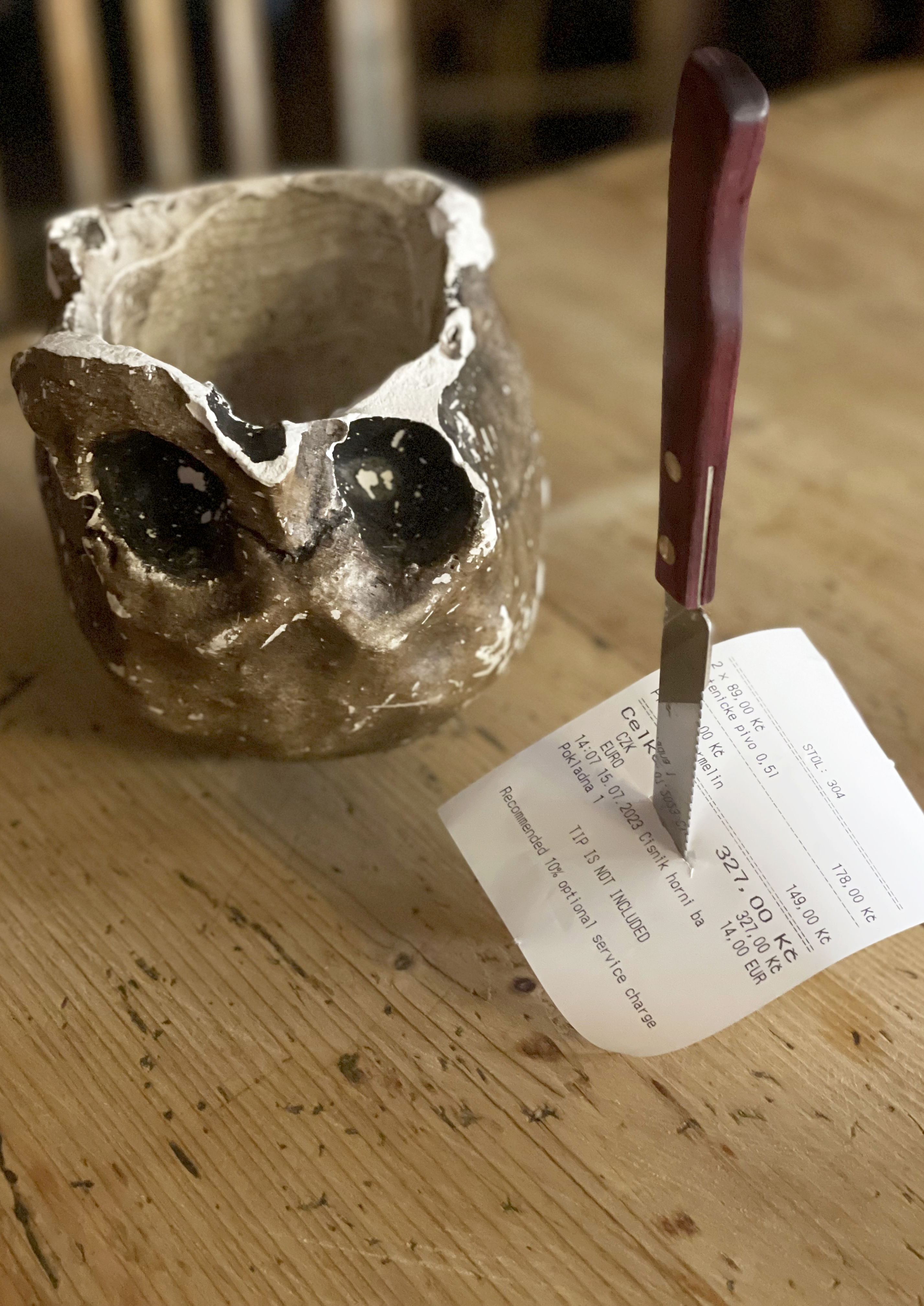
Prague, Czechia – With a grunt, the server stabs a knife into the wooden table.

It stands like an exclamation mark, piercing my bill from lunch.

Beside it sits a replica skull, into which I am to fold my bills and coins.

Open since 1375, and having only closed for a few days when one of the innkeepers murdered a patron who hadn't paid his tab, U Krále Brabantského is said to be the oldest continuously operating tavern in Prague. Word is Mozart and various Czech kings have tipped pints here.

And many, many rogues.

I'm assigned a seat beside a pair of young Franco-Australians who appreciate my initiating a conversation in French. A marinated Camembert dressed with pickled peppers and onions soon appears.

A pint of history.
The pub, located in the shadows of Prague Castle, on the Royal Way, certainly leans into its Medieval origins.

More skulls line the arched doorway.

Candles flicker over low, vaulted ceilings darkly painted with swirls of fairies and ghouls. Ethereal lute music fills the small, cavern-like rooms. Servers are intentionally gruff to hearken back to the age and they provide the percussion as they slam suds onto the simple wooden tables with rhythmic thuds.

Foam bubbles over the glass and seeps into history.

In all, it's a little hokey.

And charming enough I thoroughly enjoy it.

Thursday, July 13, 2023

On Track.

Do widzenia, Kraków; I enjoyed you.
Kraków, Poland – Steel shutters suddenly fall from the ceiling, causing travellers to scatter like ants in the rain.

They slide under the gates as police officers wave them along.

Confused, I stand watching the departures board at Kraków Główny, the city's main rail station. The screen only holds slots for a dozen trains, so it'll be a while before the EuroNight Chopin to Prague appears.

I lunge for an elevator to platform three, where I've been told my train will be. There are 10 tracks per platform and I still don't know which will be mine.

As I reach the top, the glass elevator doors don't open, even as a woman tries frantically to get in from the other side. We're locked down.

I'm 20 minutes to departure.

Well-trained.
Heading back downstairs, I ask a police officer if he speaks English and tell him I'm trying to get to platform three. "Then go," he says with a dismissive wave in the direction of the ticket desk.

It finally occurs to me we're not under attack, and that the station closes unneeded areas at night. I make it to platform three, but can only access the first two tracks. Both are full.

But not with my train.

The display blinks and Chopin finally shows platform three, track one; but the trains aren't moving. It updates again to two. The track is still full.

I suddenly remember reading that Polish train stations sometimes use the words for track ("tor") and platform ("peron") interchangeably. It must now be platform two, not track. Or is it?

Down to four minutes.

Again, I run at full sprint through crowds equally panicked about their trains. Someone tells me the train to Prague doesn't leave from platform two, as they hurry to Budapest. But I have to try.

Sure enough, on platform two: Chopin, idling lazily.

Having done my research, I know I'm in the second car and make the last dash.

Naturally, I'm at the wrong end of the train.

Settling into my sleeper cabin, I exhale. We begin rolling through the night and an illuminated Basilica of St. Anthony in Rybnik makes a punctuation mark on the day.

I'm loving this.

Sunday, October 16, 2022

King Tsutaramen.

Suica card charge, charge, recharge.
Tokyo, Japan – The coloured lines of the subway system fall before me like pick-up sticks.
 
It’s a dizzying blur of people, pastry shops and options.
 
Each of the seven major private railway companies in Tokyo is assigned a colour and a two-letter code. When the lines continue seamlessly like a rainbow, the code can be relatively easy to decipher.  

When they don’t, you might find yourself walking several blocks to a competitor’s station of the same name. Or, in my case, to the wrong competitor’s station of the same name in the completely opposite direction. 

There are so many destinations wrapped up in these bright ribbons that flow through the city like the neon signs hanging over the streets above. In Shinagawa Station, I, for the longest time, find only platforms (there are 20), and neither of the two exits. 

Sometimes it’s easy to understand why I walk. 

For Pete's sake.
And walk I did: first to Meiji Shrine and nearly up to Shinjuku City for ramen at Tsuta Ramen, the first Michelin-starred ramen restaurant (first earned in 2015 but lost in 2020). At approximately $15, I figure it's worth the walk for my first ramen and first Michelin-starred restaurant. 

I arrive to a white steel shutter, fallen to the ground like a long metal gown. The internet says it’s open, but the gate giving me the cold shoulder says otherwise. 

I can’t read the sign taped to it, but imagine it says they've sold out for the day.

Back to Harajuku station to pick up more colours for my ride home.

Saturday, October 15, 2022

Sashimi and You.

How it started.
Tokyo, Japan – A hand-painted menu is placed on our table like a piece of art we cannot understand.

A carafe of green tea follows.

While the flourish of black kanji holds the solution to our hunger, Google Translate can only give us “sea bream.” 

We shrug and point, our server similarly unsure of what we’re trying to order. But he’s eager to please. 

Having wrapped up my morning visiting Harajuku and seeing the cosplay and fashion kids lined up outside pastel-coloured crepe shops, I’ve come downtown to meet colleagues from London for the first time. 

How it's going.
Naturally, I’ve travelled around the world to have lunch with people who work across the street. 

Being open to eating anything is helpful, but we audibly sigh as elegant bowls of miso soup and of rice, topped with fresh sashimi, arrive at our table. Delicate threads of nori are perched on top like tail feathers.

It is, unsurprisingly, delicious – in a way you don’t need language to describe.

Wednesday, September 4, 2019

Staking Claim.

High-stakes competition.
Philadelphia, Pennsylvania – “One wiz wit, please."

Apparently, that's the lingo for properly ordering a cheesesteak in Philly.

The please may just be a Canadianism.

The end result, loosely wrapped in wax paper, is a hot sandwich slathered in melted Cheez Whiz (rather than “provy” for provolone) and onions (as opposed to “widdout”).

Cheese and onions: the only two answers you need to know. A sign says you'll be sent to the back of the line if you get it wrong.

I'm not sure they're joking.

Having wandered out to the Liberty Bell, through the historic district and down to Penn's Landing this morning, we've made our way to the epicentre of the city’s longstanding sandwich battle. Originator Pat’s King of Steaks sits kitty-corner to its neon-clad rival, Geno’s Steaks. The two have engaged in friendly competition since the sandwich’s creation in the 1960s.

Despite several cheese options, Cheese Whiz is somehow the 10-1 favourite, with Geno’s claiming to go through 8-10 cases of the processed product daily. Nobody said the sandwich was healthy.

Not a mistake.
Not one to miss out on an origin story, I opt for Pat’s for my first legitimate Philadelphia cheesesteak. Tangy, velvety cheese (or something approximating it, I suppose) coats a mound of shaved meat and a thin layer of onions on a fresh roll. It's pretty quiet, so we're easily able to find a seat after bouncing between separate windows for the sandwich and for a beverage.

A marker commemorating where Sylvester Stallone stood while filming the movie Rocky has been punched into the pavement beside the order window.

I don’t eat much beef, but the sandwich hits the spot. I’m not sure, however, it matched the hearty smoked salmon sandwich I had this morning at the Little Spoon Café.

Monday, July 1, 2019

Well Trained.

Shutter to think.
Lausanne, Switzerland Hustling into the charcoal-tinted underground with a mere minute to spare, I feel French flow from my lips like an unknown water source.

It's surprisingly fluid after all these years.

A weary man with a cumbersome keychain replies, saying I've found the correct train and points me toward the second-class car. After nine hours of flying, the hour-long inter-regional 90 will carry me from the airport in Geneva to Lausanne for about $25. It's handy.

And, it's sweltering. This isn't a region that generally has much need for air conditioning.

Like faded stitches across the landscape, the tracks ring the turquoise of Lake Geneva, which rests like a jewel in the Alps. The mountains, in soft focus, hem us in.

Throughout the journey, bubble graffiti rises up walls to scalloped tile roofs and tiny-peaked homes. A face has been painted around a grate, making it bare teeth at passersby. Taking a sharp corner, a vintage green Citröen makes an equally bold statement on the narrow streets below before heading into the countryside.

Vineyards cascade down the growing slopes as we near our destination.

Unsurprisingly, we arrive on time.

This is Switzerland, after all.

Thursday, September 18, 2014

Taxing.

I wanted to scoot.
Hanoi, Vietnam – Generally even-keeled, I knew I shouldn’t be annoyed.

And yet, as the taxi driver, crawling at 20 km/h, drew his eyes to the pulsating blue dot on his phone to find where he was, I felt the red rise to my face. This is a city known for taxi scams.

He was lost in the matrix of his Samsung Galaxy, as opposed to the maze of the old quarter. He didn't even offer so much as a single punch of the horn as bicycles pulled alongside. In my experience, that's unheard of.

Being dropped off a block away from my destination in rain that drove harder than he did did nothing to unfurrow my brow, especially when he had no change to offer.

“Oi zoi oi,” as the locals say. Good lord.

Over the past couple weeks, I've obviously become accustomed to the mad rush this city injects into your blood stream. It's not necessarily a good thing.

But I really shouldn’t be annoyed: while nearly double the normal fare, the 100K VND only constituted an extra couple dollars.

And driving a taxi in this city cannot be easy.

Monday, September 15, 2014

A Slice of Language.

A pizza my morning.
Hanoi, Vietnam – A smiling woman arrived unexpectedly at my desk this morning, a personal-sized pizza in hand.

She laughed and visibly searched her English vocabulary for the right word.

“Product?”

With furrowed brows and a chuckle, we scanned each other’s faces for the lexicon that would unlock the secret of the doughy creation.

“Students!”

Bingo. The mid-morning snack was courtesy of the college’s Culinary Arts program, which provides students with an understanding of the tourism and hospitality industries to provide them more stable jobs.

Best of all: no delivery fees.

Monday, September 1, 2014

Orienting Myself.

Hanoi, Vietnam – The sun is setting in the distance, making tall clouds appear to be mounds of cotton candy.

The clouds broke after a day punctuated by heavy rains, which may serve as a metaphor for having some of my apprehension relieved during a local orientation at the WUSC offices. The session was another positive step in trying to understand the contributions I hope to make.

I will be spending the next few weeks reviewing the marketing strategy at Bc Thăng Long College, trying to understand its competitors, developing messaging and making recommendations related to professionals best suited to implement the College’s marketing initiatives.

Apparently, 80 per cent of the College's students come from the nearby industrial sector, which was hard hit during the economic crisis, resulting in tremendous downsizing. As most of the remaining local industrial-zone labour force does not require specific skills – they’re mostly repetitive-task assembly line roles – the College has found it necessary to expand its catchment area to recruit.

Specific objectives like this should help drive the strategy. The next step will be to meet with College officials on Wednesday, and to begin to put ink to a work plan.

In the meantime, tomorrow is a national holiday, and high on my list is seeking out another cà phê nâu đá – which Ngoc had me order in Vietnamese today. It was easy to see why everyone raves about the country’s traditional dark roast coffee mixed with condensed milk and served over ice. 

I was the one getting an education today.

Wednesday, May 11, 2011

A New Goal.

DC and Titus, plotting World Cup dominance.
Chekalini, Kenya – Although I do not understand many words of their persistent chatter, the children here sound just like those anywhere else.

Excited. Eager. Proud.

In the blazing heat of midday, this chatter wilted as DC, Titus and I first kicked around a couple of guavas, then a ball crafted from rolled-up felt wrapped in a plastic bag and bound by twine. Games transcend the differences of culture and language that so often define our uniforms.

We laughed as we beat the ball into submission its felt unfurling like a tail and we flailed our legs wildly, attempting to communicate through the unspoken language of sport.

Taking my hand, Lincoln guided me the long way around the property to show me his school pointing out trees, flowers and other words he understood in English. With a kind smile, a funny face or an awkward dance, such differences in language can easily dissolve. In fact, sometimes language simply does not matter: some experiences are universal.

And no matter how one says it, I know I have been so tremendously blessed with my good fortune here.

Saturday, February 7, 2009

Day 27: A Word on Language.

Kitabi, Rwanda – At any one time here, the lyrical tones of a variety of languages are carried on the breeze. With everyone talking on a mobile phone, it can be a real symphony.

Many educated Rwandans are at least bilingual and often speak three or four languages, at least passably. Persistent chatter on the street is generally in Kinyarwanda, but the government implemented a policy this past year that made English the working language. Meetings, however, often dissolve into the national tongue.

I imagine the transition will be interesting – and likely challenging – in the short term, given that the policy is not being phased in. It’s already in place. Imagine waking up one morning and suddenly finding out that all of your work had to be done in a different language – one you understood little of. All of a sudden, school curricula are in English. Signs, advertisements, newspapers, overhauled.

Though it may handicap the nation in the near future, the President believes the change will help Rwanda better position itself on the global stage in the long run. English is also central to the country’s desire to join the Commonwealth.

Kiswahili – the language of much of East and Central Africa – has now also been made mandatory in schools.

Given France’s extensive historical involvement in the country, many Rwandans also speak French (though there are areas in which you may be thought less of if you do because of disgust with the former colonial power). Rwanda was once part of ‘La Francophonie’, the association of French-speaking nations, but diplomatic relations have chilled with France because of its colonial past and its role in the genocide.

On an interesting note, Kinyarwanda is blessed with a couple idiosyncrasies that can be somewhat confusing if you’re not prepared for them. For reasons I do not understand, the ‘k’ sound is often pronounced as “ch” and an ‘l’ can be pronounced as ‘r’. As an example, Kigali (where I’m headed back to tomorrow) is often pronounced “Chigari”. To add another wrinkle, ‘b’ can be pronounced as ‘v’, leaving the oral form of Kitabi as “Chitavi”.

Confused yet?

Tuesday, January 27, 2009

Day 16: Something to Quaff that Thirst.

Kitabi, Rwanda – As far as the eye can see, rolling green hills sprout foot-high plants that produce the tea I’ve been consuming a lot of lately. Watching stooped women with large bags slung over their backs perform the arduous task of picking the leaves, it’s obvious I’m indulging in one of the region’s specialties.

While I’m not normally much of a tea drinker, it’s nice to know it’s produced nearby, and to participate in the local culture. That it’s a great help in my battle to keep warm hasn’t hurt its appeal either. Tea with milk (chai) is also quite common, though I’ve found that it’s often made with powdered milk, which – for whatever the reason – I’ve tended to avoid.

Strangely, while Rwanda also produces coffee, I haven’t had many opportunities to enjoy a nice cup of local brew. Instead, what’s generally offered is a small red tin of Nescafe powdered crystals produced in Kenya – not quite what I had in mind. The search is on, though.

Given the tropical climate, fresh fruit juice is also a popular choice, though it’s best as a foreigner to be sure you know what kind of water has been used to dilute it. If it’s from the tap, you’re best to pass. I’ve had the passion fruit juice a couple times, which is quite sweet with a touch of a tang, and a popular choice around here. Plus, it just sounds cool to say to the waitress, with one eyebrow raised, “Passion”, with a seductive emphasis on the first syllable.

The chagrin I felt last year about the ubiquity of soda products is repeated here, though they seems to be less overtly advertised. There are fewer Coca Cola huts slinging glass bottles of the fizzy drink and fewer buildings either painted the familiar bright red or festooned in Coke banners. I wonder if this may be partly because the climate is more temperate and less dry.

Oddly enough, the generic term for soda here is Fanta (which is a Coke product), though you must specify if you’d like orange or citron, or a Coca. A bottle here is not quite as cheap as in Tanzania, but is still inexpensive, running around 300 FRw, or about 60 cents. Conversely, a small bottle of water generally costs about 500 FRw – a dollar – so the same problem exists.

The two main Rwandan beers are Primus and Mützig, though many people also drink Amstel, which is Dutch. Interestingly, unless you specify otherwise, you will be brought either the large 75 Cl bottle, or two smaller bottles, depending on the make (Amstel doesn’t produce the larger version). Though I haven’t come across any yet, Rwandans area also known for their ‘home brew’ – a banana beer.

Primus is seen as the more blue-collar beer, where Mützig comes clad in a shiny white foil label. While something may be lost in the translation, someone told me people here have an expression about Primus; it’s the beer that makes children say: “Daddy, please stop taking beer so that we can afford to buy sugar.” A large bottle will set you back just more than a dollar. The expression about Amstel, on the other hand, is to the effect of: “Anna-Maria, go home and make the bed.” 
 
I’ll let you draw your own conclusions.

One last note on beverages: as people drink beer, soda and water both ways, you’ll also have to specify if you’d like it cold (“aconje”) or warm (“inshyushye”).

Saturday, January 24, 2009

Day 13: Losing Myself in Peace.

Kitabi, Rwanda – A dozen children, wearing clothes as dark as their skin, first dive into the bush, then chase after me down the road that leads into Nyungwe National Park. “Bonjour, Madame (sic). Comment allez-vous?” “What is your name?”Muzungu – where do you come from?”

Such phrases echo behind, then alongside me, with differing degrees of both enthusiasm and timidity. They are, for the most part, greetings these children have learned in school and don’t really constitute the basis for substantive conversation. One of them appears to be trying to push her friend into me so that someone can say they touched the muzungu who had wandered past their village. They're all extremely excited to see themselves on my camera's screen, pointing themselves out to their friends.

Adults, sitting nearby and minding even-smaller children who cling to the hems of their mothers’ garments, smile in amusement and offer up a gentle “muramutse” (good morning) in reply to my greeting in Kinyarwanda. While Nyungwe is a tourist destination, most visitors simply pass through here in the blur of a hired car, and on to the area deep in the forest inhabited by chimpanzees and golden monkeys.

In other words, it’s not overly common for a 6”3 white man to casually stroll past their small plots of land, many of which are occupied by a clay house, a few stalks of corn and a cow that smells as though it has been wallowing in its own filth. Because it has been. Outside one, a one-year-old plays with a small hoe; looking around, agriculture is unquestionably in his future.

Though a little overcast, it is a nice Saturday morning in Kitabi and I had decided after breakfast to go for a walk, with no real objective in mind. Two hours later, I had left my home here behind, wandered through the buffer zone that leads to Nyungwe and up into some of the Park’s hills. It’s easy to lose track of time in the beauty and peace of these surroundings.

Once I leave the roadway, butterflies flit, seemingly aimlessly. Bright red birds scream at each other before darting across the path in front of me when I pause to breathe in the scenery. Vines tap me on the shoulder. Forest elephants used to roam these hills, until the last one was killed during the war in 1994. There’s talk about re-introducing them to the area in the near future. Branches around me crack mysteriously, and yet it all seems so quiet. Peace, much-needed.

Deeper into the forest, crickets chirp in chorus like a relaxation CD, and yet remain somehow haunting. I’ve remained on the lookout for the military patrols that roam the forest as I have no desire to be startled by a group of camouflaged and heavily armed men. They often seem to simply appear out of the forest like ghosts emerging from the low-lying cloud. Many insurgents hid out in Nyungwe following the war, though most have since made their way to the DR Congo. The military presence is here to ensure it remains that way.

It is so silent, and the hills so steep, that you can hear trucks rumbling like thunder long before you see them. Bus drivers careen around corners, the rubber of their tires barely clinging to the rims. Some honk; others wave. Shrivelled corn cobs, picked clean, litter the side of the road. It’s a common snack while driving here, and you can often see roasting pits along the way.

Thunder has begun to murmur over the hills and the first drops have begun hurtling themselves earthward. In the distance, the silky string of rain completes the tapestry of Kitabi. Emerging from the forest, I see a bicyclist making his way down the hill and, around the corner, another man who appears to be smiling in my direction.

My colleague Richard has come looking for me.

Thursday, January 15, 2009

Make a Run for the Border.

Cyangugu, Rwanda – Today was a pretty non-descript day of work, planning and editing at the retreat, but I did take time to look out from the patio where I was working outside and marvel at the sun shining down on the mountains, the exotic birds chirping all around me and the proximity of DR Congo, right across the lake. In short, it was pretty cool – there are worse ways to work. And yes, I’m well aware of how lucky I am to have this opportunity.

At the opening of the retreat, we learned the meanings of everyone’s names in Kinyarwanda, which varied from “Always exceeds expectations” to “By the glory of the grace of God”. It was neat to hear the cultural relevance of their names and we discussed whether naming children in this manner was believed to help them become self-fulfilling prophecies. We were told there’s a saying in Kinyarwanda that is roughly “Your father may not hit you, but may curse you with a bad name.” So, I guess the answer is yes.

After the day had wrapped, a few of us decided we wanted to go down to the DRC border to ask if we could take a step into the country and pose with the Welcome sign. Zany, perhaps, but some of the group has done it before and it’s not usually a problem. Today, however, the border was a little too quiet as the thousands of people who cross it every day for work had already made their journeys. We made it to within a few feet, but turned away.

I have spoken a lot of French today, getting to know some of the KCCEM staff a little better. Many speak Kinyarwanda, Kiswahili, French and English, but a number feel more comfortable speaking to me in French. It’s also likely that doing so slows me down a bit and makes me easier to understand than I am in English. It has left my mouth sore from using muscles I use so seldomly, but it was also rewarding to carry-on conversations for a half-hour at a time without many struggles, particularly given my usual hesitancy to speak the language.