Showing posts with label Religion. Show all posts

Thursday, November 6, 2025

Hide and Souk.

A DIY reflecting pool.
Casablanca, Morocco – Stepping off the bus, we’re immediately surrounded by touts.

And shouts. 

“Taxi? Taxi! Taxi!!!”

It's humid. Motorcycles bray like New Year’s noisemakers as they rip through crosswalks. Angry horns echo.

Pretending to know where I'm headed, I press firmly through the crowd – now five deep – and across the street. Only one man follows before realizing I was serious when I said "no, thank you."

I may not really know where I'm going, but I have a decent guess. 

The Hassan II Mosque is pretty hard to miss.

Its ornately detailed minaret rises from the ocean, drawing the day’s haze onto the sky. At 210 metres, it’s the second tallest in the world.

Hewn from marble and granite, the mosque is covered in intricate mosaics and features a retractable roof. It can accommodate more than 100,000 worshippers at a time, including 25,000 inside.

Funky cold medina.
We wander down a broad avenue lined with palm trees and into the narrow stone alleys I love so much to lose myself in. Mechanics make repairs from tiny wooden shacks fronted by mattresses, surrounded by pungent aromas of petrol and of the day's catch.

A young man on a stool uses a wooden block to tap a knife as he breaks down a large fish. Beside him, another cleans squid. Farther along, women gossip at a small storefront filled with spices. I'm surprised people largely leave us alone, offering only a soft "bonjour" and a smile.

We alternate our replies in Arabic and French. 

Apart from taking in the bustle and untangling the threads of jagged streets, the rest of the old souk is a disappointment: it's filled with counterfeits and cheap trinkets. Nobody even glances up from their phones to try to sell us anything. 

Just like home.

I'm privileged to be back on my favourite continent for a fifth time, which has brought a very different experience – but one that's still reminiscent.

And one that makes me feel alive in a way few other things do.

Tuesday, November 4, 2025

Unmoored.

Missed a spot.
Granada, Spain – It begins with perfume.

The Alhambra’s tall, labyrinthine gardens gently whisper love letters in jasmine, rose, cypress and orange.

Bright red pomegranates – granada in Spanish – hang like festive balls on a Christmas tree. It’s one of the best-smelling places I’ve visited in a long time.

Inside, it’s also one of the most breathtaking.

Built primarily by the Nasrid Dynasty between 1238 and 1358, the palace and fortress complex is among the best-preserved monuments of the Medieval Islamic world. 

Modest exteriors belie the explosion of geometric tile, marble and intricately carved stucco inside. Swirls of calligraphy have been etched repetitively into the walls as though a student had to repeat a lesson learned on a chalkboard.

Courting lions.
There's an intense beauty to be found in consistency.

In Islamic architectural tradition, rooms open through arched doorways into central courtyards lined with sharply manicured box hedges and reflecting pools. The serene, liquid canvas of the Court of Myrtles would eventually inspire the Taj Mahal.

Having fallen to Christian conquest, the Alhambra became a Spanish royal court in 1492. As a result, the city is a fascinating blend of Moorish, Gothic and Spanish Renaissance architecture that speaks to 800 years of Andalusian history, religion, community and culture.

Walking into the Hall of Ambassadors, we feel a faint connection.

Here, behind the flicker of a thousand pinpricks poked into the shutters, Columbus received royal endorsement for his journey to the Americas.

It's like the stars aligned. 

Saturday, November 1, 2025

Feeling Familar.

Searching for a pot of God.
Barcelona, Spain – The towering sandstone forest of La Sagrada Familia is bathed in a warm glow of ambient colour.

Flames flicker on the floor. Sunrise stretches over branched ceilings.

It's as though all seasons are present at once and you can't help but look up – to gawk, even. When I last stood on this spot 30 years ago, it was the site of a gift shop and of continuous construction.

Now, it's a place of prayer in the world's tallest church.

And, next year, after 144 years, the chisels are rumoured to finally stop – construction of the basilica will be complete. 

Walking around the south side, though, I have my suspicions.

Having received one of the earliest entrance times, I step outside and have the entire front of the building to myself. 

I'm lost in the enormity of the moment.

Intricate carvings appear to crawl from the stone. Seasonal fruits in reds and oranges adorn the spires, dotting the sky with colour. A green cypress tree, reminiscent of Christmas, is decked with 21 doves. Delicate bronze trumpets, muted and turned green, are pressed to stone lips.

I may not be the slightest bit religious, but I'm still awed.

And humbled by Gaudi's vision.

Saturday, June 21, 2025

Thunder Run.

The Golden Rule.
Rivière-au-Tonnerre, QC – Needles shed by windswept pines stitch together La Route des Baleines in north-eastern Québec.

Despite hours slaloming the coast, we see no whales. Nor moose, which diamond-shaped signs warn us of at regular intervals. For me, tradition holds.

It is, however, a beautiful-beyond-words drive through the jagged curves of mountains, which open their arms into countless lakes and into the St. Lawrence. Blues touch fingers with the horizon. 

I'm not sure I've taken a more stunning roadtrip east of the Rockies.

At one point, we comment about the lack of tunnels chiselled into the rock. One immediately appears around the next corner. I downshift. We try the same with moose.

Nothing.

On a roll in Sept-Îles.
Our only stop is at Casse-croûte du Pêcheur, in Sept-Îles. There, we have a lobster roll in a restaurant shaped like a giant, kitschy lobster pot. It's nicely toasted and tasty, but contains too much filler. 

Arriving at L'Escale Lam-Air is like stepping into a 1950's-era seaside motel. And I mean that in the best possible way. A Post-it note tells us our key is in the door to the room. We're well beyond cellular service and tourist season hasn't yet started – the hotel doesn't have full-time staff.

In other words: a great place for vacation.

We step off our back porch onto soft sand and over massive rocks filled with fossils, including one of a full fish. Gulls squawk, but we otherwise settle into silence before cracking a crab-flavoured beer

The sun set sets in glowing amber through the windows of Saint-Hippolyte church and upon a day filled with more beauty than expected.

But, still no whales.

Vitals:

  • Time: 10 hours, 8 minutes
  • Distance: 591.2 kms
  • Province: Québec
  • Weather: Sunny and warm
  • Wildlife: None

Thursday, May 15, 2025

Flagging Hunger.

I found E.T.
Bratislava, Slovakia – It’s my last full day.

Naturally, I've decided to tack on even more international travel. 

Bratislava is only an hour away and, unlike earlier in the journey, the train clearly indicates where you are and where you’re going – in German and in English. Even better, a roundtrip ticket includes municipal transport upon my arrival.

Remnants of the communist era are immediately evident. Bland concrete boxes and stone statues with rugged chins are contrasted by narrow Medieval alleys etched into the old town and by a wide, leafy promenade along the Danube. The city is beautiful, interesting and different.

In addition to wandering through the old town, I’ve visited the Art Nouveau Blue Church, Bratislava CastleUFO Bridge and Slovak Radio, an inverted pyramid often named one of the world’s ugliest buildings. The city is a patchwork of styles.

End of the line.
Having worked up a hunger, I've escaped the wind and rain by stepping into Bratislava Flagship, a former monastery built in 1672. It would eventually become a cinema and is now one of Europe's largest restaurants. From tiny doors to religious iconography, though, the building’s past is never far from sight.

Aromas of roasting meat waft through the air as house remixes of Cher and Elton John thump over endless wood and marble. An ornately carved fireplace sits incongruously against the wall, but no more so than the clay Bethlehem that fills the stage – it's reputed to be the country's largest.

Bratislava Flagship is a feast for the eyes and for the stomach.

A din rises from below as crowds finally pull up to the long tables. The restaurant, which holds 500, has just begun filling up. Sporting a t-shirt emblazoned with "Bar Tislava," my server delivers a dark, house-made monastic beer and a plate of slow-roasted pork, dumplings and sauerkraut. I'm told it's traditional.

And it's delicious.

What a cool experience – I’m really glad I’ve made the trip.

Tuesday, May 13, 2025

Habs(burgs) and Hab Nots.

Life's a ball in Kugelmugel.
Vienna, Austria – Scale.

It’s the first word that comes to mind to describe Vienna.

Not necessarily the size of the city itself – although my legs may argue after another 30-kilometre day – but everything feels massive. The Hofburg Imperial Palace, St. Stephen's Cathedral and Vienna State Opera may not be the world's largest on their own, but taken collectively, they lend the city a certain weight.

It pays to have a dynasty – and a sense of self-importance. 

There remains a symbolic and very real presence of the Habsburg monarchy, even today. Marble. Spires. Fountains. Sculptures. Blocks of perfectly shaped buildings in neutral tones, like delicately piped cakes.

As important to Viennese culture as opera.
Horse-drawn carriages clop through Michaelerplatz, the centre of city life since 1 AD. There’s so much history sculpted into these buildings and fountains, each of which burbles with its own stories.

I've spent the day wandering through and around the old town, gawking at the views, each of which seemed to surpass the last.

(And sipped Viennese coffee on Stephanplatz, as people have for centuries.)

Across the city: the opposite end of the spectrum. An orange sphere is tucked behind an eight-foot-tall barbed wire fence in the Prater amusement park. It appears to make an surprised face. Welcome to the Republic of Kugelmugel, a self-described 'micronation' built in the 1970s as a piece of protest art.

It's a far cry from the types of pageantry you'd see at balls elsewhere in Vienna.

Friday, May 9, 2025

Looking Down.

Buda Castle, from Pest.
Budapest, Hungary – If you can look down, you’re in Buda. 

Pest is flat.

Now one city, Budapest is divided by the Danube, which once marked the edge of the Roman Empire. I’ve crossed Széchenyi Chain Bridge to Fisherman’s Bastion and Buda Castle, which stand proudly over the river.

These are no doubt two of the city’s most magnificent and popular attractions.

Fisherman’s Bastion twists and curves like a stone sandcastle, offering stunning views for miles. Tourists jostle for the best photos.

The only moment without people.
Behind it stands Matthias Church, where the final two Hungarian kings were coronated. A gold crown is set into the base of a cross atop the colourfully tiled roof. Perched nearby, a black stone raven represents the 'Raven King,' Matthias Corvinus, considered the country's greatest monarch.

Approximately 80 per cent of the Castle District was destroyed during the Second World War. The subsequent Communist regime simplified many structures during its rebuild.

Damage from the Russian siege is still visible today. As I round a corner, pockmarks scar the face of the national archives, providing a very tangible reminder of some of the area's less regal history. 

The sound of guns has been replaced by jackhammers. 

Now a UNESCO World Heritage Site, the complex is being rebuilt to its original designs. Ornate facings are held up by steel beams as historic landmarks, including the Royal Palace, are brought back to their previous splendour.

Today has felt like every destination is 2.5 kilometres away, which I now need to reverse if I want to check in to my hotel. 

I pass an oxidized bronze statue of Baron Eotvos Jozsef, which stands imposingly outside a brown, early 1980s-era Intercontinental Hotel. It's a bit of an anachronism.

As in so many cities, parts of Budapest have begun being glassed over.

But for now at least, its history hasn't been glossed over.

And the walk back is flat.

Wednesday, May 7, 2025

Square Dancing.

Lining up for more.
Braşov, Romania – The old town kisses you with gelato-coloured buildings. Misty hills rise behind them. 

Braşov is beyond-words beautiful. 

Lines of white cobblestone, set out in squares, draw me immediately to the Council House, built in 1420. Now a museum, it was once home to city hall, markets and witch trials.

Several groups of school children move through the square like chess pieces. Adults tuck into restaurants lining the perimeter. All the while, chatter is caught in raindrops.

I love squares like this: six hundred years later, it's still a hub of activity.

The Black Church looms over one corner, incongruous with other structures. It's the largest Gothic church in Southeastern Europe and lighter bricks used in its restoration make it appear pixelated.

Squares within a square.
Nearby, I squeeze myself through Strada Sforii, believed to be one of Europe’s narrowest streets. Its length is scribbled with names and testaments of love.

As the rain exhales, bright umbrellas flutter like insect wings.

Atop one of the hills, a sign spells out Braşov in white letters. Everything is so beautiful I can only assume I've found myself inside a Hollywood movie.

And tonight, I’m staying in the third-oldest building on the square.

It was built in 1477

This is amazing.

Monday, May 5, 2025

Pieced Together.

Bucharest, Beiged in Light.
Bucharest, Romania – A glass shatters over loose cobblestones, scattering like misplaced stars.

Mid-day, revellers are already filling the narrow arteries of the old town.

Only 20 years ago, this area was in pieces. So many of the city's resources had been redirected that buildings were left derelict, providing convenient shadows for crime.

Now, it’s a bustling stretch of open-air cafés and restaurants frequented by locals and tourists alike. The old town’s beauty has been repainted, its history renewed.

On cue, a line of river cruisers shuffles past, eyes somewhere between their phones and the orange flag they obey. As in so many European cities, the old town has become somewhat of a theme park.

Graffiti, an ages-old problem.
Falling in behind them, I stop at the popular Caru’cu Bere for lunch and enjoy a dish of confit pork, smoked sausage, sauerkraut and polenta. Waiters in white shirts and beige aprons hustle past with tankards of house-made beer.

Naturally, one stops at my table.

The 140-year-old restaurant turns over 2,500 patrons a day, only 40 per cent of whom are tourists. While known for the dark wood, arches and stained glass of its Gothic Revival interior, it’s the patio that’s packed under today's spring sun.

Across the road stands the ornately painted Stavropoleous Church, which has stood for more than 300 years and seen Bucharest through its many transformations. 

Around the city, jackhammers put the exclamation mark on its most recent. What will 20 more years do to scrub some of the more recent history from its walls?

It’s a great afternoon and a reminder that, sometimes, tourist areas are that way for good reason.

The Weight of History.

The world's second-largest administrative building.
Bucharest, Romania – Heat curls from my brow as I set out in search of the entrance to the Palace of Parliament.

Weighing more than nine billion pounds, it’s the heaviest building in the world. Unsurprisingly, it sinks six millimetres a year.

It's also a monument to former dictator Nicolae Ceaușescu's vanity and to his power to destroy more than seven square kilometres of the old city centre while uprooting 40,000 people and redirecting much-needed financial resources. 

Today, it’s more than 70 per cent empty. Built with a million cubic metres of marble, it’s the showy white wedding cake nobody needs.

The sun beats down as I make my way up Spirea’s Hill, along the south side of the building. Gold domes shimmer against the sky. Within the same complex, construction continues on the People’s Salvation Cathedral, which is expected to open later this year.

Naturally, it’s the largest Orthodox church in the world.

After more than an hour, I make it to the entrance, which was mere feet from where I had started.

But in the opposite direction.

I don’t even go in.

Friday, May 24, 2024

Hearsestad.

Harstad, Norway – The blue line on our map blinks, guiding us on a five-kilometre hike through the town's neighbourhoods.

It's all uphill.

There's a peppermint chill to the air, but the sun is alight, dancing in and out of thin cloud.

A bell tolls.

This morning, a beige hearse is parked in front of Trondenes Church. Built of stone in 1435, it's the world's northernmost surviving Medieval building, let alone church. 

It stands simply in white, having no doubt grieved its share of funerals.

Inexplicably, people are vocally upset about being unable to go inside.

Leaving the grumble behind, we continue uphill in an attempt to see the massive Adolf Gun, which formed part of Hitler's Atlantic Wall – a 5,000-kilometre network of coastal defences stretching from France to the top of Norway.

With a range of 56 kilometres, the guns were the largest ever based on land.

It turns out trying to visit something on an active military base takes a bit more planning than we've done: there are no tickets available today.

Birds chirp, sounding like camera shutters. Ptarmigan? Perhaps they're photographing our dismay.

Closing the map, we find a far shorter route back, tracing the water and past overturned wooden fishing boats. Sunlight sparkles over snow-capped mountains.

It's not only infinitely more beautiful, it's flat.

Thursday, May 23, 2024

In a Sound.

Not a sea day.
Honningsvåg, Norway – My reverie is shattered by the deep baritone of the ferry’s horn.

A motorcycle responds with a rev.

Echoes crash off zebra-striped mountains enveloping the sound, which provides sanctuary for the countless colourful boats anchored here this morning. Tall metal rods stand from their decks like matchsticks. 

The fish must be similarly silent today.

Despite having only 2,200 residents, Honningsvåg is considered the northernmost "city" in mainland Norway. Its painted homes are nestled into the rock, with backyards that cascade into the ones below. Snow fences are stitched onto the hills to protect them from heavy Arctic winters.

Capain Kirk.
It snowed only three days ago, and various pockets of water are still frozen over.

But, signs of spring: a mossy green canvas of lichen stretches out like fingers into the crevasses. At eight degrees, it's somehow still warm enough for short sleeves.

There's not much here, but sloped roads carry us to a white church that – apart from its green steeple – would seem to disappear in winter. 

Sort of like many organized religions in this day and age.

When occupying German forces retreated in 1944, they burnt Honningsvåg to the ground.

The Neo-Gothic church was the only building to survive.

Tuesday, May 21, 2024

Coronation Street.

An Olav branch.

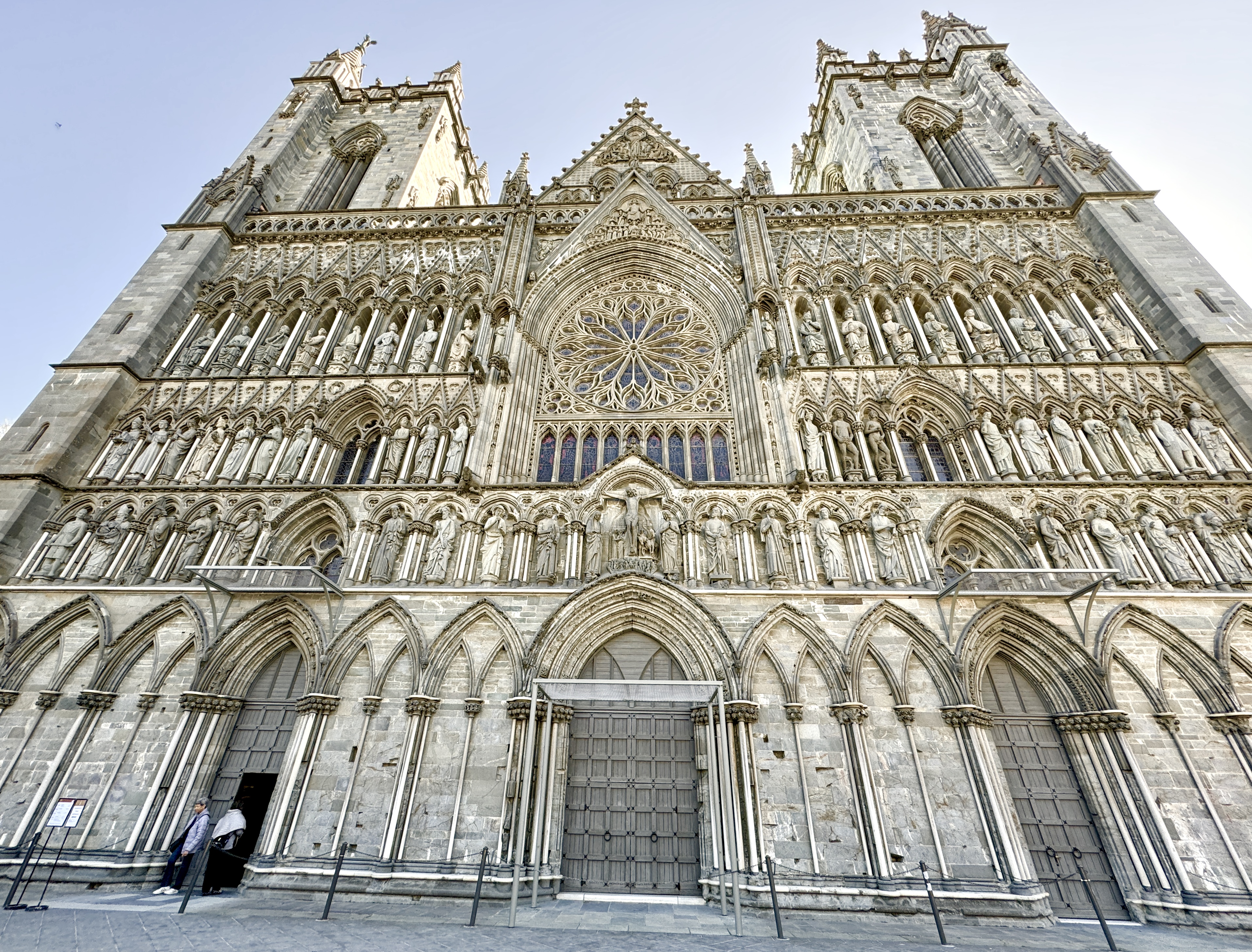
Trondheim, NorwayNidaros Cathedral looms over the centre of Trondheim.

And over the country’s history.

Built atop the grave of St. Olav, between 1070-1300, Nidaros was an important pilgrimage for Northern Europeans during the Middle Ages. For centuries more, kings were crowned within its walls.

This morning, the cathedral's massive rose window sparkles in the sun, a kaleidoscope shimmering from its petals.

Between light and darkness.
As I look up, I'm awed by the the rebuilt west front, which is faced by brownish-grey stonework as intricate as lace. Fifty-seven statues stand like chess pieces, severe countenances etched upon their faces.

In a twist, the one topping the north-west tower is modeled after Bob Dylan

By the nineteenth century, Nidaros was a crumbling shell of itself, having been destroyed by fire, decay and neglect. Restoration continues today.

By all accounts, Trondheim itself is a phoenix

The former national capital has been rebuilt multiple times following massive fires, including one in 1651 that reduced 90 per cent of it to cinders. Today, the wooden wharf of Bakklandet is tinted by the yellows and reds of the bird’s feathers.

Dwarfed.
Throughout Trondheim, bridges seem to serve as braces, holding together a town straddling past and future.

An old crane looms like a steel robot, its hook arm hanging languidly, out of work.

Amidst the buzzing of drills, old shipbuilding yards are fading into condos, hotels and restaurants. Monuments to the town’s nautical history rust alongside dry docks that haven’t been embraced in years. Brick walls have been scrubbed of their pasts.

Trondheim: being born yet again.

Sunday, December 17, 2023

Kicking Back.

This show has legs.
New York City, New York – Music builds in concert with the orchestra rising from the cavernous Radio City Music Hall stage.

It's an apparition with woodwinds.

Then, percussion as dancers tap in unison, microphones tucked into their shoes. Dressed as reindeer, revellers and wooden soldiers, they twirl and kick like ribbons of colour, rhythmic in the breeze.

Santa Claus slides in on a sleigh before multiplying in a chorus of "ho ho hos." A young boy's eyes grow wide at the appearance of 40 more, each popping up in spotlights around the theatre.

More than 1,100 costumes and pairs of shoes are used in the Rockettes Christmas Spectacular.

A very New York City holiday experience.
While much of the show hasn't changed since its debut in 1933, some immersive elements now require 3D glasses. More than a million pairs are handed out each year.

Drones flutter through the auditorium like fairies and pyrotechnics bring the performance to a close with a bang. With 160 synchronized high kicks each show, you'd have thought there would already be enough entertainment.

In the last scene, the stage grows dark and becomes serious. No more colourful helpers making toys.

Real sheep, donkeys and a camel trot slowly across the stage, drawing a line to the nativity scene. It may be the reason for the season, but it's a drastic shift in tone from the rest of the show.

Santa must have needed a break.

Sunday, June 9, 2019

Venti Selfie, Extra Foam.

We've addressed this.
Singapore — Today, we have woven new into old.

This morning, we set out down Arab Street, stepping into colourful fabrics and stained glass lamps that wink in panels of red, yellow and blue. The narrow streets nearby carry us into a pocket of hostels and the cheap tackiness that tends to accompany them.

Brightly painted Mexican murals, it turns out, attract selfie hunters. So much for seeing Singapore.

One one side of the street, a shop prints these selfies onto your coffee — no, really. The thought makes my eyes roll, but everyone needs to make a living and the joy of travelling so often involves taking the good with the bad. At least they know their market.

Allah t'a History.
Prayers from the golden-domed Masjid Sultan, built in 1824, soon thunder down the alley, calling my ears to the area’s true majesty. The base of each of the national monument’s domes is decorated by glass bottle ends donated by lower-income Muslims. Everyone’s ability to contribute to the mosque’s construction has helped foster a community.

Our next steps take us back to yet another era as we perch ourselves at the end of a dark, wooden bar. Punkah wallah fans sashay their hips from the ceiling over a staircase that corkscrews at the centre.

Slinging.
Raffles Hotel, in all its colonial glory.

A vintage drink shaker is kept busy as orders flow for the iconic Singapore Sling, invented here. As a writer, I give a nod to Rudyard Kipling instead, ordering the golden milk punch, which was conceived of for the author and topped by a tuft of saffron. As is tradition, we toss peanut shells onto the floor while we wait for the abysmally bad service.

It beats the cockroaches that would be beneath our feet in the hawker centres.

Looking around the room, I can’t help but realize it’s colonialism cum Disneyland.

But we have a great time anyway.

Back to the future, we take in the laser and light show at the Marina Bay Sands, perching ourselves beneath the Merlion’s spit. Lines are drawn across the sky twice-nightly to muffled sounds, crowds with tripods waiting for the Earth to move.

While a fine evening out, it doesn't.

Sunday, December 16, 2018

Psalms and Palms.

Arch nemesis.
Castries, Saint Lucia – Like most, it’s a palm Sunday in Saint Lucia.

The streets are predominantly shuttered and even the steel sheet-covered Castries Market and Vendors Arcade, built in 1891, has fallen silent, apart from a few scattered tables of clothes and trinkets. The central fountain, sporting a lion's head and a mosaic basin, bears a large sign announcing "No smoking. No Spitting."

Hymns from the Cathedral of the Immaculate Conception, meanwhile, sway through the breeze in their best Sunday dresses.

They carry with them the colour of the islands.

All that remains is the palms, bent at the waist, sharp leaves like combs, rattling against the blue sky: nature’s percussion.

Friday, December 14, 2018

A Grave Situation.

Things are looking up.
St. John’s, Antigua – We’re greeted by steel drums, snackettes and open sewers that threaten to ensnare unaware tourists.

A few shorebirds salute lazily between equally paced clouds.

Looming above the city, perched on a central hill, stands St. John’s Cathedral – also known as St. John the Divine. Its third incarnation, built in 1847, is immediately recognizable for the two tall towers rising from its roof.

The Cathedral hangs there like a weather-beaten halo.

Over the years, its face has been pockmarked by repeated storms and earthquakes. Windows wink with missing panes.

Broken pieces lay wrinkled on the lawn: doors, shutters and marble tombstones have been stacked like jagged teeth forcibly knocked out. Most are so old family likely no longer visits.

The building’s pain is obvious, and testament to nature usually winning, regardless of faith. Crossing the threshold, however, we’re greeted by rib after rib of light wood pew in high polish.

Despite the punishment the building has endured, its heart is obviously strong.

Sunday, October 14, 2012

Almost Gone (dola).

Venetian pizza delivery.
Venice, Italy - Wispy clouds, like flaming feathers, fanned dart-like trails left by the passing planes that pinned the sky's eyelids awake.

We had arrived in Venice to a colourful, albeit cooler, morning.

Taking bridge after bridge, people literally poured out of jigsaw streets on temporary, raised sidewalks into St. Mark's Square, which was awash in six inches of water brought by the rising tide. Venice is, after all, composed of 118 islands.

Each has a church.

We visited the Doge's Palace, which was the seat of government until Venice ceased being an independent republic in 1797. On the 'secret tour,' we saw where decisions were made and the archives were kept, as well as the cell from which Cassanova escaped.

No, he didn't leave his little black book behind, either.

As the tides ebbed, Mass began in the square, which was punctuated by a beautiful choir.

And, of course, the whirring flap of pigeons.

Friday, October 5, 2012

Going with the Flo-rence.

Shuttered, on the Ponte Vecchio.
Florence, Italy - Strains of wheezing accordion danced through the piazza like an out-of-breath dance partner.

An antique carousel with pastel-painted horses stood at the centre, ringed by street artists spinning names into wire and hawking just-painted watercolours and distorted caricatures.

Everything was a circus of art.

The narrow, jagged streets spill out into many such squares in Florence, which are also filled with markets selling leather goods, stationery and textiles industries for which the area is internationally known.

Ponte Vecchio which, because of its history, was the only bridge not blown to smithereens during the second world war twinkles with gold vendors, and one can only imagine it lit up at night.

At the city's centre lies the massive Duomo the fourth-largest church in Christendom, which is built of a patchwork of multicoloured marble hewn from the nearby hills, which makes them appear snow-capped.

Nearly 500 narrow stone steps carry you to and from the top of the cupola even bringing you face-to-face with the massive frescoes inside the dome, while providing unparalleled views of the red clay-shingled buildings below.

It's the romance of Italy as I had imagined.

A Pisa Marble.

Come on, Aileen.
Pisa, Italy - As you first walk through Pisa's medieval stone gates, it's as though white marble sprouts in all directions from the verdant, manicured lawns.

All built entirely of marble, the intricately detailed baptistery, church and bell tower occupy a beautiful complex right within the city of 90-thousand's stone wall. Of course, most are here just to see the famous bell tower, which curves skyward like a banana. It's worth the visit.

Given the region's notoriously muddy conditions, there are actually several leaning towers in Pisa, but the others are like long-forgotten stepsisters. The so-called leaning tower of Pisa where Galileo is said to have performed some of his (literally) groundbreaking studies of gravity has actually leaned since it was built during the 10th century.

All around, people appeared to be performing tai-chi, but were actually embodying the cliché tourist photograph: posing with hands extended like a praying mantis to hold the tower up.

Sigh. Yes, I did it, too.