Showing posts with label Food and Beverages. Show all posts

Saturday, November 1, 2025

Time Tapas.

Something's fishy.
Barcelona, Spain – A perpetual motion machine twists behind the thin, marble bar at La Plata.

He smiles, spinning the spigot of a barrel set atop the fridge.

Without so much as a splash, house-made red wine falls in a graceful arc into thimble-sized glasses. It's a perfect dive.

As he has for 50 years, Pepe Gómez moves effortlessly, serving small plates of fried anchovies. Washing glasses. More anchovies. Wiping down the counter. A plate of sausage. Tossing out smiles and jokes with regulars. 

And mentally tabulating bills of the growing crowd, which spills out onto the darkened street.

Based on faded photos on the wall, it seems little has changed since the small, corner establishment opened in 1945. It feels like you could be stepping into any one of them.

Still six tables. Still four tapas on the menu. And still a crowd celebrating the end of the day.

Set amidst the wallpaper of tourist shops hawking cheap trinkets in the Gothic Quarter, a moment of authenticity.

Friday, October 31, 2025

Small Plates of Barcelona.

3.14 tapas for the price of one.
Barcelona, Spain – The blue dot on the map doesn’t budge.

It just winks, apprehensively.

Despite confidence we’ve hopped onto the right train from the airport, our lips are curled into question marks. “There’s only one way you can go,” I tell myself. “And there are other tourists aboard.”

And yet, we seem to be circling farther north.

Suddenly, we arrive at Passeig de Gracia station and hurriedly grab our bags. Stepping out into a bustling Barcelona evening, the blue dot finally careens across the screen, marking our real location. 

The GPS has awoken from its slumber.

We wander through the Gothic Quarter, which has come alive for Halloween. Men in top hats and long, dark coats lead ghost tours through jagged alleys lit at crooked angles in cigarette yellow. In a small square, a full choir of buskers breaks out in a beautiful rendition of Let it Be.

We settle into a table in an adjacent square for vermut de Reus and tapas, both exhausted from the day and equally giddy at the prospect of patatas bravas, octopus parmentier and a shimmering plate of Jamón Iberico.

Two buskers swing by the table, crooning Valero, expectantly holding out cups between bites.

It's a warm welcome to Barcelona.

Saturday, June 21, 2025

Thunder Run.

The Golden Rule.
Rivière-au-Tonnerre, QC – Needles shed by windswept pines stitch together La Route des Baleines in north-eastern Québec.

Despite hours slaloming the coast, we see no whales. Nor moose, which diamond-shaped signs warn us of at regular intervals. For me, tradition holds.

It is, however, a beautiful-beyond-words drive through the jagged curves of mountains, which open their arms into countless lakes and into the St. Lawrence. Blues touch fingers with the horizon. 

I'm not sure I've taken a more stunning roadtrip east of the Rockies.

At one point, we comment about the lack of tunnels chiselled into the rock. One immediately appears around the next corner. I downshift. We try the same with moose.

Nothing.

On a roll in Sept-Îles.
Our only stop is at Casse-croûte du Pêcheur, in Sept-Îles. There, we have a lobster roll in a restaurant shaped like a giant, kitschy lobster pot. It's nicely toasted and tasty, but contains too much filler. 

Arriving at L'Escale Lam-Air is like stepping into a 1950's-era seaside motel. And I mean that in the best possible way. A Post-it note tells us our key is in the door to the room. We're well beyond cellular service and tourist season hasn't yet started – the hotel doesn't have full-time staff.

In other words: a great place for vacation.

We step off our back porch onto soft sand and over massive rocks filled with fossils, including one of a full fish. Gulls squawk, but we otherwise settle into silence before cracking a crab-flavoured beer

The sun set sets in glowing amber through the windows of Saint-Hippolyte church and upon a day filled with more beauty than expected.

But, still no whales.

Vitals:

  • Time: 10 hours, 8 minutes
  • Distance: 591.2 kms
  • Province: Québec
  • Weather: Sunny and warm
  • Wildlife: None

Wednesday, June 18, 2025

Bedeviled.

Finding this place wasn't a fluke.
Rivière-Ouelle, QC – A driftwood whale sits atop La Baleine Endiablée, bleached by the sun.

It's home for the night after more than 11 hours and nearly 1,100 kilometres on the road. The sun has finally come out at the end of a day painted in blended greys.

So has my French.

Unsurprisingly for us, the auberge hosts a nanobrewery. Out back, picnic tables overlook farm fields that roll up into the mountains,  glistening in the distance. It has been a long, but not particularly taxing day. Still, the idyllic setting is a welcome respite.

We've settled around plates of méchoui – Québecois barbeque pork – with gravy, coleslaw and spiced fries. The server arrives with a 9.5% barleywine.

In a pint glass.

The devilish whale, indeed.

Vitals:

  • Time: 11 hours, 14 minutes
  • Distance: 1,091.9 kms
  • Provinces: Ontario, Québec
  • Weather: Fog, cloud and rain, leading to sun
  • Wildlife: None

Thursday, May 15, 2025

Flagging Hunger.

I found E.T.
Bratislava, Slovakia – It’s my last full day.

Naturally, I've decided to tack on even more international travel. 

Bratislava is only an hour away and, unlike earlier in the journey, the train clearly indicates where you are and where you’re going – in German and in English. Even better, a roundtrip ticket includes municipal transport upon my arrival.

Remnants of the communist era are immediately evident. Bland concrete boxes and stone statues with rugged chins are contrasted by narrow Medieval alleys etched into the old town and by a wide, leafy promenade along the Danube. The city is beautiful, interesting and different.

In addition to wandering through the old town, I’ve visited the Art Nouveau Blue Church, Bratislava CastleUFO Bridge and Slovak Radio, an inverted pyramid often named one of the world’s ugliest buildings. The city is a patchwork of styles.

End of the line.
Having worked up a hunger, I've escaped the wind and rain by stepping into Bratislava Flagship, a former monastery built in 1672. It would eventually become a cinema and is now one of Europe's largest restaurants. From tiny doors to religious iconography, though, the building’s past is never far from sight.

Aromas of roasting meat waft through the air as house remixes of Cher and Elton John thump over endless wood and marble. An ornately carved fireplace sits incongruously against the wall, but no more so than the clay Bethlehem that fills the stage – it's reputed to be the country's largest.

Bratislava Flagship is a feast for the eyes and for the stomach.

A din rises from below as crowds finally pull up to the long tables. The restaurant, which holds 500, has just begun filling up. Sporting a t-shirt emblazoned with "Bar Tislava," my server delivers a dark, house-made monastic beer and a plate of slow-roasted pork, dumplings and sauerkraut. I'm told it's traditional.

And it's delicious.

What a cool experience – I’m really glad I’ve made the trip.

Wednesday, May 14, 2025

A Central Experience.

A rarity: Café Central with no line.
Vienna, AustriaCafé Central’s not the sort of place I typically visit.

Too many tourists gawking at overpriced pastries and vaulted ceilings, wanting to be part of an approximated history that’s been written here. Or nearly here.

But the traditional Viennese café is such an important part of the city’s mystique that I’ve been the tourist I am and come for breakfast and a Melange. In a nod to traditional etiquette, a spoon is placed upside down atop the glass of water set alongside my coffee.

While the café is in a different part of the building than when it opened in 1876, it maintains a sense of charm and gravitas. Gone is the thinker’s salon known for epic battles of chess and heated discussions of the day’s politics.

Instead, social media influencers pose in front of glass cases filled with ornately decorated patisseries.

At one time, you’d have found the psychologist Freud, the artist Klimt, the architect Loos and countless writers spread across the café, poring over newspapers and writing their next oeuvres.

You may have also shared a table with Trotsky, Lenin, Stalin or Hitler.

They’re obviously name-dropped less.

History is fluid. A cultural touchstone like Café Central still sets the scene, allowing you to connect to a different time and to imagine the electricity of thought that filled the hall.

The reality that it was originally located a few feet away changes little.

Tuesday, May 13, 2025

Habs(burgs) and Hab Nots.

Life's a ball in Kugelmugel.
Vienna, Austria – Scale.

It’s the first word that comes to mind to describe Vienna.

Not necessarily the size of the city itself – although my legs may argue after another 30-kilometre day – but everything feels massive. The Hofburg Imperial Palace, St. Stephen's Cathedral and Vienna State Opera may not be the world's largest on their own, but taken collectively, they lend the city a certain weight.

It pays to have a dynasty – and a sense of self-importance. 

There remains a symbolic and very real presence of the Habsburg monarchy, even today. Marble. Spires. Fountains. Sculptures. Blocks of perfectly shaped buildings in neutral tones, like delicately piped cakes.

As important to Viennese culture as opera.
Horse-drawn carriages clop through Michaelerplatz, the centre of city life since 1 AD. There’s so much history sculpted into these buildings and fountains, each of which burbles with its own stories.

I've spent the day wandering through and around the old town, gawking at the views, each of which seemed to surpass the last.

(And sipped Viennese coffee on Stephanplatz, as people have for centuries.)

Across the city: the opposite end of the spectrum. An orange sphere is tucked behind an eight-foot-tall barbed wire fence in the Prater amusement park. It appears to make an surprised face. Welcome to the Republic of Kugelmugel, a self-described 'micronation' built in the 1970s as a piece of protest art.

It's a far cry from the types of pageantry you'd see at balls elsewhere in Vienna.

Saturday, May 10, 2025

Rebirth in Ruins.

Wonderland.
Budapest, Hungary – Last night is painted onto people’s faces.

The Jewish Quarter has become party central.

As they stumble along, I wonder how many revellers think of what happened on these streets 80 years ago. They’ll have passed various memorials and the Dohány Street Synagogue, which is the largest outside Israel. More than 2,000 victims of the Arrow Cross are buried in the courtyard.

It’s sobering.

And yet, I’ve come to visit Szimpla Kert, a former stove factory now brimming with greenery. It’s the last of the original ‘ruin bars’ and a distinctly Budapestian experience. Twenty-five years ago, people began reclaiming buildings abandoned since the war, giving them – and the community around them – new life. 

They were filled with mismatched furniture and cheap beer. And, as importantly, with people. 

Bathed in disco light.

Today, a flea market fills the entrance and sun streams through colour-blocked sheets flapping gently over the courtyard. Pink flamingos and gnomes wink behind plants sprouting from disco balls. It's wild.

In one room, a cracked tub serves as a bench, set beside haphazardly strewn stools, mottled with spray paint.

Each space is its own tattooed warren covered in scribbles that tell the stories of years of wild nights. Of loves longed-for. And of anarchy, which seems to align with the feeling of the place. 

But lighter.


Ruin bars have breathed new life into forgotten spaces, making the area one of the trendiest in Budapest. The sands of time are stacked on top of each other.

Still, as I leave, I step across one of 32 bronze strips embedded into the pavement – and back into history. 


They mark the locations of the old ghetto walls.

Poor Marketing.

Stop and stair.
Budapest, Hungary – Although it’s Saturday morning, the Central Market Hall is hushed. It opens at six.

Two hours later, most stalls remain shuttered.

The emptiness is filled with aromas of spice and baked breads. Sausages hang like the church bells echoing through the mostly empty hall. 

Cases of meat are laid out in symmetries, gradients of red. Bouquets of paprika clutch to steel gates. Fruits, nuts, wines and lavender soaps await the day’s rush.

In the meantime, I admire the silence and the sun streaming in at sharp angles.

But I would have loved to have found some breakfast.

Wednesday, May 7, 2025

Put on the Flow.

The mici cut the mustard.
Braşov, Romania – I look up with a smile, saying I don’t need help with the menu.

My young server, Dimitrie, raises an eyebrow. The Beer Corner offers a wide variety of traditional Romanian dishes and he's genuinely surprised.

I may have been wrong.

He looks at me quizzically as I try to order mici without bread or mustard, and explains that “bread is a necessity.”

“It’s how we eat them,” he adds with a grin.

The garlicky, uncased sausages are one of the main things on my culinary checklist for this trip. Mici, meaning “little ones,” are nearly ubiquitous in Romania, as the country consumes 440 million of them a year.

Dimitrie says he’ll “put me on the flow,” making me hip to eat them like a local. As they arrive with a sizzle that tickles my nostrils, I can’t help but say he was right. Again.

Dinner also includes Tochiturà de porc, a meaty plate of braised pork, sausage, pickle salad and polenta topped with a fried egg and telemea cheese. It’s tasty and filling, but the sheer saltiness draws any remaining moisture from my body.

Reflexes of an aging cat.
Seeing the need for refreshment, Dimitrie tips my glass and fills it with beer. He winks, saying “Perfect pour, right?”

As I get up to leave, he asks if I’d like to play a drinking game, pointing to a digital clock I hadn’t seen behind me. Stop it at exactly 00:10:00 and you win 20 per cent off your meal.

I miss by a hundredth of a second.

Dimitrie has been so great I give him the 20 per cent as a tip instead. 

There's not much of a tipping culture here and the machine isn't programmed to take that much. My turn to put him on the flow.

Tuesday, May 6, 2025

Nacho Problem.

(Ground) Zero service.
Bucharest, Romania – I missed Cinco de Mayo by a day.

Naturally, it's in Bucharest that I find some of the best nachos I've ever had, in a craft beer bar just off University Square.

At Ground Zero Beer, they use four different cheeses, including bleu, roasted red peppers, pickled jalapeños and bacon. Funk and salt assault my taste buds.

But they’re really tasty.

It has been surprisingly challenging to find traditional Romanian cuisine here. Maybe it's the way the world's going, but the city seems largely to have moved on from its food history.

As I discovered the first day, there’s a grab-and-go culture of sandwiches, breads and pastries – shops along the street are often lined up. And there's a lot of pizza (insert joke about the Roman Empire): only the United States orders it more.

It makes me feel that I’m missing out on less as I work through my nachos. Service here is indifferent at best, but I soon realize the imperial stout I've ordered is 12 per cent.

And has been served in a pint glass.

A tasty afternoon, indeed.

Monday, May 5, 2025

Pieced Together.

Bucharest, Beiged in Light.
Bucharest, Romania – A glass shatters over loose cobblestones, scattering like misplaced stars.

Mid-day, revellers are already filling the narrow arteries of the old town.

Only 20 years ago, this area was in pieces. So many of the city's resources had been redirected that buildings were left derelict, providing convenient shadows for crime.

Now, it’s a bustling stretch of open-air cafés and restaurants frequented by locals and tourists alike. The old town’s beauty has been repainted, its history renewed.

On cue, a line of river cruisers shuffles past, eyes somewhere between their phones and the orange flag they obey. As in so many European cities, the old town has become somewhat of a theme park.

Graffiti, an ages-old problem.
Falling in behind them, I stop at the popular Caru’cu Bere for lunch and enjoy a dish of confit pork, smoked sausage, sauerkraut and polenta. Waiters in white shirts and beige aprons hustle past with tankards of house-made beer.

Naturally, one stops at my table.

The 140-year-old restaurant turns over 2,500 patrons a day, only 40 per cent of whom are tourists. While known for the dark wood, arches and stained glass of its Gothic Revival interior, it’s the patio that’s packed under today's spring sun.

Across the road stands the ornately painted Stavropoleous Church, which has stood for more than 300 years and seen Bucharest through its many transformations. 

Around the city, jackhammers put the exclamation mark on its most recent. What will 20 more years do to scrub some of the more recent history from its walls?

It’s a great afternoon and a reminder that, sometimes, tourist areas are that way for good reason.

Sunday, May 4, 2025

A Silent Smile.

Perfect strangers, abandoned.
Bucharest, Romania – The city smiles through chipped teeth.

A bygone splendour is tucked into the spiderwebs of cracked pink paint, rusted balconies, bleached façades and abandoned buildings. Beautiful Beaux-Arts awnings unfold like glass leaves.

They’re set against an adjacent symmetry of brutalist concrete cubes remaining from more than 40 years of communist rule. Lines upon lines upon lines.

In more ways than one.

Having to squint a little to see the remains of a city once described as ‘Little Paris of the East’ isn’t really much of a surprise. Covered in tattoo-like graffiti, Bucharest appears to wear much of its tumultuous history on its sleeve. Times have often been hard.

As a country, Romania has long been at the crossroads – and in the crosshairs – of various imperial powers and fascist regimes. Given these challenges, it’s easy to appreciate that smiles can at first seem harder to come by.

Like parachutes, falling from the sky.
I join one of the many fast-moving, but not insignificant, lines for a  Luca Traditional – ham and cheese baked into a pretzel – before settling onto the patio at Hop Hooligans. The air gets a jolt as friends come together over craft beers. It’s a great spot.

Heading back to the hotel, I walk through an alley with hundreds of umbrellas strung overhead. They paint a rainbow in the sky.

The city’s smile widens ever so slightly.

Nearby, a child-in-arms teases his mother with a giggle. Pouting teens tug on skinny cigarettes. An older woman presumably asks me for money. And others hustle along with groceries.

If there’s one thing I’ve learned from travel is that languages may change, but regardless of our different and often-complicated histories, we are – at the core – very much the same.

Bună ziua, Bucharest.

Wednesday, May 29, 2024

Close Call.

Trust me, I'm not a church.
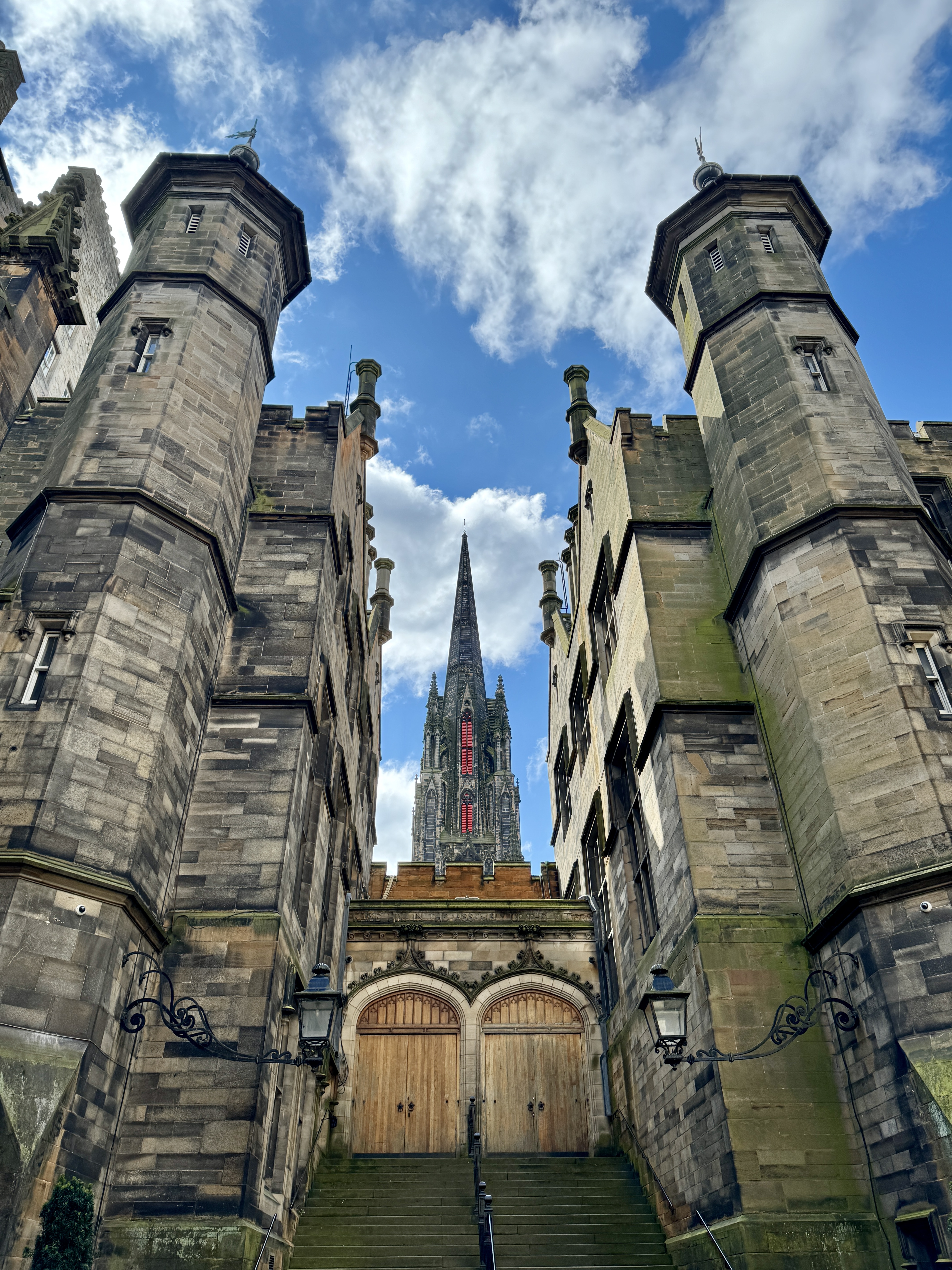
Edinburgh, Scotland – A Gothic spire rises from the heart of the Royal Mile like a singed needle.

Striking red shutters hang from it like jewels, which seems incongruous for an old church.

Except it’s neither particularly old, nor a church.

Built in the mid-19th century, the Hub is now a public arts and events space cloaked as a house of worship. It was constructed as a meeting hall for the Church of Scotland, and has hosted congregations over the years, but was never actually consecrated.

It still feels weird to sip beer in the courtyard.

Advocate's Close.

Initially unable to find tickets to Edinburgh Castle, we wandered the length of the mile to the Palace of Holyroodhouse, the official residence of the British monarch in Scotland. Naturally, it’s closed on Tuesdays and Wednesdays. 

Back uphill.

With each creaky step, centuries of history whisper to me through the many closes that branch off like fish bones. But I also feel – far too closely – the present. Crowds jostle past in the heat as they inch up the cobblestone road, which is stitched with countless tourist shops offering scotch, colourful wools and tweeds.

It’s a different version of close.

Mid-way, some good news. A bus tour provider sells us tickets to the castle, which looms above, perched on the edge of an extinct volcano – people have lived on this rock for at least 3,000 years. It’s a steep walk up to the iconic structure, which is braced by multiple layers of defences.

Top of the rock.

I can’t imagine making the trek in armour, let alone with arrows and cannon firing around me. And at me.

We’re rushed through a thick safe door and past the Scottish Crown Jewels, then to a small room where Mary Queen of Scots gave birth to her son, James, who would eventually unite the British and Scottish crowns, in 1603. 

Forlorn school groups mope in queue.

In the prison, we find graffiti scratched onto the walls and doors. Some of it dates back to the 1700s, including one of the earliest depictions of the American flag. Some things never change.

At 4 p.m., our first rain of the entire trip. 

Stone gargoyles become fountains, spitting on us from overhead. Time to pop into the Ensign Ewart for a dram and a pint.

After all, there has been a pub here since 1680.

Tuesday, May 28, 2024

Kilty Pleasures.

Scotch on the rocks.
Kirkwall, Scotland – Fog rolls in fast, like an early cinema reel.

For an hour, history fades into nature, only to be re-illuminated by yet another day of sun. This isn’t the Scotland I’ve heard so much about.

Having similarly faded into history, the Bishop’s and Earl’s Palaces stand as hollow sheaves of their former grandeur. The former was built in the 1100s – no wonder its ruins are dark, cold and empty. Long open to the elements, only whispers of ornate stonework remain around the fireplaces in the grand hall.

Stone ribs are all that remain of the two buildings.

Across the street, a massive, red sandstone structure looms over the city. It's far more intact.

A little dead out this morning.
Dating back to the same time, St Magnus Cathedral is both the oldest cathedral in Scotland and the northernmost in the United Kingdom. Now a parish church of the Presbyterian Church of Scotland, it’s technically no longer a cathedral. 

Semantics.

Following tiny Medieval roads that spread out like spider webs, we're greeted by the golden aroma of fry grease. A chippie is a must.

Leaning against a stone wall in the alley, we tuck into into a tray of glistening fish and chips from the Happy Haddock. A fried ball of haggis comes in a paper bag. 

It's my first, and gummier and more seasoned than I had imagined.

A Dark Island Reserve from Orkney Brewery washes it down.

Haggis and a scotch barrel-aged beer – Scottish enough for you?

Where's my kilt?

Monday, May 20, 2024

Breathless.

An exercise in beauty.
Ålesund, Norway – With each step, my lungs embrace the clear, northern air – passionately and frequently, like young lovers.

My legs scream in a way my voice no longer can.

Climbing the 418 steps to the top of Mount Aksla isn’t particularly hard, but it’s steep enough after several days of inactivity. Perhaps I shouldn’t have taken them two-by-two. 

I’m told it’s easier now that many of the steps have been paved for The Amazing Race, which replaced many of the uneven stones.

As I reach the top, the panoramic views across the archipelago offer a salve for even the most ardent joint pain. It’s warmer than the advertised 10 degrees, and the views are unparalleled.

Petals, blown onto buildings.
The sky has stretched out in endless blue, draping itself over jagged mountains lined with snow like the stringy white hair of so many of those wandering around us. Colourful Art Nouveau buildings are set onto the canals like pointed candies.

Small boats exhale curves of white plume that waft over this important fishing port as we slouch into a picnic table for a pint at Molo Brew.

A jackdaw cries from the branch overhead. 

With nearly everything closed for Whit Monday, it’s one of the few sounds we hear.

Apart from a series of clinks, followed by“skål.”

The adventure is officially underway.

Friday, May 17, 2024

A Great Dane.

Become a star flyer at Tivoli.
Copenhagen, Denmark – Obscured behind the tall walls of Tivoli Gardens, rides whirl like the flip of a poodle skirt caught in the breeze.

The Star Flyer climbs steadily, twisting as would a spider ascending to the heavens.

At one end stands a mountain of fibreglass, its tip dipped in white. The stiff flag at its peak points to the north. Opened in 1843, Tivoli is the third-oldest amusement park in the world.

The oldest is only 10 minutes away.

Rather than go inside, we sit on a green box edging the sidewalk and eat a pølser wrapped in bacon, painted with remoulade and topped with a sprinkle of crispy onions. It’s the extent of our carnival today.

But it’s a (very) good one. Even the late Anthony Bourdain raved. Yes, about a hotdog.

Anyone have a corkscrew?

So I sit with shoulders shrugged, hopeful the sunshine will erase the grogginess that comes with having been plied into an airplane seat that doubles as a straitjacket. It has been a long day of travel and we’re hanging on by an eyelash for our limited time in Copenhagen.

The only clouds are in my head, but exhaustion still feels like wool, tucked above my temples.

It’s a national holiday in Denmark and others obviously feel better than we do. For Constitution Day, they walk along the various canals, well-dressed in white with Danish flag ribbons stuck to their chests. 

Many swing open bottles of wine.

Although we typically walk everywhere, we maximize the value of our 24-hour transit passes by taking water taxis around the city, including to the Little Mermaid and the lesser-known Genetically Modified Little Mermaid. Flags rattle against silent masts, pinned to the harbour. 

Nyhavn: a box of crayons.
We pass long lines of people tanning casually along the shore and among Nyhavn's wood and plaster structures, which groove in shifts of bright colours. Most are more than 350 years old. 

Sunlight offers a bright, white exclamation mark that cascades on indifferent ripples in the water.

Turning the corner, a small boat pops out from under a shallow bridge, a table set at its centre. A bottle of wine stands sentry.

I could get used to this.

Sunday, December 17, 2023

Let's Meat.

A Katz above.
New York City, New York – Today, the midday line outside Katz's Delicatessen is only a half-block long.

In relative terms, it's short.

Neon signs hum as we huddle against a light drizzle, a whisper of steam forming on our breath. It spells anticipation.

Moving inside, we pick up our tickets (don't lose them: you need them to get out) and scan the packed room for the shortest carving line and a table. Unsurprisingly, there will be a wait for both. 

Meanwhile, cutlery duels, plates clatter and people shout. Chairs screech across the floor.

The man in line in front of me doesn't seem to know what he wants and the server becomes visibly frustrated. Patience is not a New York virtue.

An oasis in the chaos.
The guest's saving grace is that he speaks Spanish. First opened in 1888, the Kosher-style deli may be the city's oldest, but it also signifies New York's shifting demographics: most of the staff today are Latin American.

As a middle ground, the carver offers, in Spanish: "Do you want pastrami and corned beef?"

He's as relieved to see the man gather his tray and push through the jostling crowd as he is to hear I know exactly what I want: pastrami on rye with brown mustard, a bowl of matzo ball soup and a side of pickles.

A wish for knish.
The carver throws a few juicy slices onto a plate set on the counter: time-honoured samples. Katz's goes through 30,000 pounds of meat in a given week and still expertly carves it by hand in front of you. I drool even at what's considered scrap and tossed aside. His knife spins, a glint in its eye.

The bustle and show are half the experience.

But only half: the sandwich is piled high with thickly cut meat, the crunchy pickles are sour and the matzo ball is the size of my fist. You have to be particularly careful to not spill any as you push against the stream to find a table.

A bite. Bliss.

While hardly still hungry, dessert comes in the form a a fresh cherry-cheese knish from the 120-year-old Yonah Schimmel a few doors down.

It's so hot and delicious it melts into my soul.

Saturday, December 16, 2023

Parked.

New York City, New York – Aromas of baked goods and cheese dance in the air as raclette melts, twisting off the blade and onto a baguette.

Ice skaters twirl in parallel.

Frankly, it's a nice respite from the smells of weed and booze that seem to permeate the city.

Set up like chess pieces, the green-framed huts in the Bryant Park Winter Village serve as magnets for holiday crowds by offering crafts, gifts and food of all varieties. Passers-by tug on cups of hot chocolate so thick one merchant advertises that chewing isn't allowed; another twists freshly boiled pasta into a 70-pound wheel of Parmesan.

Jostled by endless lines of people, I feel the same.

But the sun twinkles on the tall Christmas tree and off the skyscrapers surrounding Bryant Park, whose revitalization over the past couple decades has allowed it to shed its previous "Needle Park" moniker. It now breathes a European flair into the city.

We trace the grid back up to Broadway, where we see Hamilton at the Richard Rogers Theatre, which has housed more Tony Award-winning Best Plays and Best Musicals than anywhere else. As expected, the show is great, but the theatre is cold, cramped and today has only one operational restroom. 

Patrons aren't thrilled.

But a post-show visit to New York landmark Junior's takes the (cheese) cake.

Friday, December 15, 2023

Finding Free.

Breakfast at Tiffany.
New York City, New York – "Beautiful smile, but I can't pay the rent with it," says an elderly man with a heavy Italian accent.

He doffs a tweed cap as he crosses the subway platform, his hands gesticulating as though drawing a caricature.

"Neither can I," I reply with a chuckle.

Not much in this city is cheap – not talk, not even the knock-off Gucci purses and faux high-end watches unceremoniously pulled from garbage bags and laid out on sidewalks. The packaging is a metaphor.

Fifth avenue is certainly no place to look for discounts. Its store windows, however, are beautifully animated for the holidays and come to life in sharp angles of colour and glitter. Bears dance the can-can behind the glass.

Bergdorf: good, man.
Having also wandered through Central Park, we stop at Judge Roy Bean for a beer and to toast my favourite young lady's birthday from afar. 

A sparkling silver purse sits on the patio table like the disco ball that will soon fall in Times Square to usher in the new year. We hand it to the server, who asks another table if it belongs to them.

A young woman shrieks in relief, not yet having realized it was gone.

As we prepare to leave, the server tells us the woman's friend has picked up our tab as thanks. "Good karma, and happy holidays," she says with a smile.

On our way home, we stumble upon a bourbon tasting and happy hour at the hotel. Both are free.

In a city this expensive, I'll take it.