Showing posts with label Art. Show all posts

Tuesday, June 24, 2025

A Grey Time.

A blank page unfolds before me.
La Malbaie, QC – Greys slip into nothingness.

As we set out to the mainland, the air swells with pregnant fog. It's like peering through wax paper as the boat pushes into folded waves. Ripples vanish even before they form.

We've joined a group of daytrippers for a tour to Île Nue de Mingan, which sprouts with nature's flowerpots. It's a stone chessboard laid bare by high winds. Beauty, in nakedness.

Botticelli would be proud. 

It's a nice, free trip where we're somehow the only ones not sporting bright red lifejackets – until the horrified captain notices us shivering. An Indigenous member of the tour picks a stick up off the stone beach and tells us it has come from the mainland. It's been gnawed by a beaver.

And there are none here.

Unfortunately, what's gnawing at me now is that we have to cover 1,800 kilometres by the end of day tomorrow.

And we don't reach our car until near noon.

Vitals
:

  • Time: 8 hours
  • Distance: 668.9 kms
  • Province: Québec
  • Weather: Fog, burning off into beauty
  • Wildlife: Porcupine 

Tuesday, May 13, 2025

Habs(burgs) and Hab Nots.

Life's a ball in Kugelmugel.
Vienna, Austria – Scale.

It’s the first word that comes to mind to describe Vienna.

Not necessarily the size of the city itself – although my legs may argue after another 30-kilometre day – but everything feels massive. The Hofburg Imperial Palace, St. Stephen's Cathedral and Vienna State Opera may not be the world's largest on their own, but taken collectively, they lend the city a certain weight.

It pays to have a dynasty – and a sense of self-importance. 

There remains a symbolic and very real presence of the Habsburg monarchy, even today. Marble. Spires. Fountains. Sculptures. Blocks of perfectly shaped buildings in neutral tones, like delicately piped cakes.

As important to Viennese culture as opera.
Horse-drawn carriages clop through Michaelerplatz, the centre of city life since 1 AD. There’s so much history sculpted into these buildings and fountains, each of which burbles with its own stories.

I've spent the day wandering through and around the old town, gawking at the views, each of which seemed to surpass the last.

(And sipped Viennese coffee on Stephanplatz, as people have for centuries.)

Across the city: the opposite end of the spectrum. An orange sphere is tucked behind an eight-foot-tall barbed wire fence in the Prater amusement park. It appears to make an surprised face. Welcome to the Republic of Kugelmugel, a self-described 'micronation' built in the 1970s as a piece of protest art.

It's a far cry from the types of pageantry you'd see at balls elsewhere in Vienna.

Monday, May 12, 2025

The Golden Hour.

A golden kiss.
Vienna, Austria – Centuries-old gardens are finely trimmed into pointy finials.

A robot mows the lawn in zig-zags.

The anachronism momentarily breaks my reverie about how generations of royalty lived at Belvedere Palace. I’ve sat here an hour, absorbing the sun, the largesse, the detail.

Nearly a kilometre long, the Baroque gardens slope toward the old town, connecting Upper and Lower Belvedere. Spray from tiers of fountains sparkles like diamonds, falling into the outstretched hands of ornately carved marble cherubs.

It’s refreshing in the heat.

Historically, people cooled off in the towering, reddish-brown – and aptly named – Marble Hall, found inside Upper Belvedere. Topped by a massive fresco painted in 1721, it's also where the Austrian State Treaty was signed in 1955, re-establishing the country's sovereignty.

The remaining rooms are filled with priceless masterworks – it has been a day of art. Rodin. van Gogh. Munch. Schiele. And the world’s largest collection of Klimt.

As I make my way through the crowd, newlyweds and lovers cluster, arm-in-arm, in front of his most famous.

The Kiss.

A Mini Adventure.

Tribute to Jewish war hero, Hanna Szenes.
Budapest, Hungary – My train leaves in three hours.

As ever, I’m ready painfully early.

There's no point pacing around a hotel room, so I've set out to find some of the more than 30 mini statues artist Mykhailo Kolodko has scattered across the city.

For the most part, they're unsanctioned guerrilla art, but when you find one, you want to find others. Like Pokémon: gotta catch 'em all. 

Some teach history; others make a political point – sometimes pointedly. Seeing one of a Russian hat protesting the country's influence in Hungary, a far-right politician destroyed it with an axe.

Kodolko replaced it with a mini statue of an axe.

Today, someone has tied a pink knit scarf around the neck of a bronze aviatrix soaring from a rock in a park. A small plant has been tucked into a diver's hand outside New York Café

The other holds a symbolic key to the landmark institution.

Farther along, a roadster rounds a planter. An orange Garfield has replaced a dog on an old chipped fence. Winnie the Pooh hangs from a honey pot. Noah's Ark is set with different colours of glass, shedding rainbows. It pays to look up. And to look down.

I partly wish I had known about these statues sooner.

But surprises like these are a part of the fun and whimsy of travel.

Sunday, May 11, 2025

Bathed in Glory.

We can be heroes.
Budapest, Hungary – Having covered nearly 60 kilometres on foot the past two days, I figured I’d take it easy. Maybe soak in one of the city’s popular thermal baths?

No. You will walk.

I hadn’t yet seen Heroes’ Square, 3.5 kilometres away. It’s big. It’s daunting. It’s colonnades and bronze statues: men and horses turned bluish-green with age. It's impressive.

In short, it’s Europe.

Behind it, a castle that hadn’t made my itinerary. After all, there are so many.

Unlike most, however, Vajdahunyad Castle is a hodgepodge of buildings from across the country and across architectural styles: chess pieces from various sets clustered at the centre of a board. Set on a still pond, it's beautiful in its confusion.

An oxidized statue of Anonymous sits hooded in the garden, his pen rubbed back to its original bronze. Overhead, birds chirp like old tin toys. It's a fun find in the middle of City Park as the sun finally breaks through.

Only later do I realize I've been standing beside the famed Széchenyi thermal baths all along.

Saturday, May 10, 2025

A Hard Cell.

A building with its own headline.
Budapest, Hungary – For decades, 60 Andrássy Avenue was the last place you’d want to find yourself.

Now, it’s a popular tourist attraction.

The House of Terror Museum is set in the former headquarters of both the pro-Nazi Arrow Cross and the communist secret police. It’s a symbolic address in the minds of generations of Hungarians.

The museum, though, is almost cinematic.

A Russian tank crouches in the lobby, metaphorically leaking oil as abrasive rock riffs fill the courtyard. The soundscape whisks you through a series of sets and period pieces. An eerie standup bass gives way to light strings.

Then, a black car appears, suddenly lit behind a curtain – as you imagine it would have in the middle of the night.

As a monument to those punished by two of the country’s recent totalitarian regimes, I find it almost too glossy, too much of a modern art piece. That feeling only ends, temporarily, after I slowly descend into the basement.

It’s where political opponents would vanish into cold stone cells, knuckled under fists of fury. There, in the shallow air, my imagination can finally sketch out their horrors.

If you ended up in there, you may have ended there.

Friday, May 9, 2025

Soles, Departed.

Budapest, Hungary – Sixty pairs of iron shoes of all sizes line a stretch of the Danube.

Several are filled with red flowers.

Others bear ribbons or have the remains of burnt-out candles interspersed between them. Stickers about the ongoing crisis in Gaza have been affixed to a low wall. 

It’s a sombre memorial commemorating thousands of Jews killed by the fascist Arrow Cross during the final years of the Second World War. 

Their shoes held value, so they were told to take them off before being shot, falling into the river.

Naturally, tourists crouch, posing for beauty shots amidst the footwear. Anything for the ‘gram.’ 

I’m starting to wonder if social media is ruining travel. Or, maybe, just respect in general.

Thursday, May 8, 2025

Fang You Very Much.

For some, the décor a-Peeles.
Braşov, Romania – Our guide Dan plays DJ as he weaves through the mountains.

Occasionally, he looks up at the road.

In multiple languages, he sings along to jazz, the Rolling Stones, the blues and Pink Floyd, which he breaks up with helpful history of the region. He's lived in Brașov his whole life.

Our first stop is at Peles Castle, a Neo-Renaissance palace constructed for King Carol I, the first king of Romania. Its interiors seem to be carved from dark wood and gold. Ornate Murano glass chandeliers cascade from the ceiling with colourful, falling leaves.

Portraits painted by Gustav Klimt hang in the entranceway. There's a lot of detail to take in.

I find it interesting that there’s a Moorish salon, a Turkish Parlor and a Florentine Room, in addition to spaces styled after the British and French. Dan tells us Carol I respected different cultures, even if he was at war with them.

Maybe the rooms just gave him a place to put his trophies.

All-Bran.
Our guide produces strong coffee from a thermos before we proceed to Râșnov Fortress, which is closed for renovations. It has stood since the 1200s and was likely due for a freshen-up, even though it no longer needs to worry about cannon fire from the Ottomans.

Our last stop is Bran Castle, often referred to as ‘Dracula’s Castle.’

It's not really. 

A couple Americans thought it would help sell tickets if they tied the Transylvanian castle to Bram Stoker's literary vampire. And it has. 

Gold star, marketing team.

Vlad the Impaler, often considered to be the inspiration for Dracula (also erroneously), was not, in fact, from Braşov, but from rival neighbour, Wallachia. Still, signs around the property show a fork missing its middle tines to look like fangs. Another, a pointy crown, dipped in blood.

(I grudgingly find them clever.)

Built in 1377, it's pretty inside, and less ornate than Peles Castle. I creak over floorbards and duck under low doorways. Beloved Queen Marie – the last queen of Romania – modernized the castle in the early 20th century and painted flowers on many of the beams and doors.

In a full-circle twist of fate, it's now owned by a Habsburg.

I love history. But it has been a lot for the day.
Saturday, May 25, 2024

Ensnared.

Drumming up business.
Bodø, Norway – Church bells chime, their tinkles and dings giving rise to a five-minute song.

With a rumble, rows of women in bowler hats and black wool overcoats drum along. A clash of cymbals welcomes the Arctic sun.

We’ve followed 35 members of the Bodø Paradekorps from the city centre with unexpected excitement. Who had "parade" on their bingo cards?

I hadn't had high hopes for Bodø, which is nestled right above the Arctic circle and is far more modern than most Norwegian towns we've visited. It's not particularly beautiful, but large pieces of street art add splashes of colour.

A stark clock tower stands beside the concrete cathedral, as does the detached tower of town hall, which is linked only by a small bridge. It's like the crane never showed up. 

A spray of colour amidst the concrete.
At the harbour, young men teeter into a floating sauna. Another sells fresh shrimp from his boat.

Two large mesh fish greet us, mouths agape, as we stumble upon a pop-up art exhibition. A DJ blips and bloops. We clap politely during introductions, not understanding a word. We blend in like watercolours.

I’ve tucked my expectations of the town back into my pocket.

Bodø is, apparently, a European capital of culture for 2024 — the northernmost one ever. It seems there has been a “northernmost” of everything on this trip.

Add in a landscape hemmed in by towering mountains, and a sky that melts into a darker blue sea, and it has been a fantastic day.

Travel is so often about these unexpected moments and unforeseen experiences.

It's a reminder to keep an open mind, and to be willing to explore.

Thank you, Bodø.

Tuesday, May 21, 2024

Coronation Street.

An Olav branch.

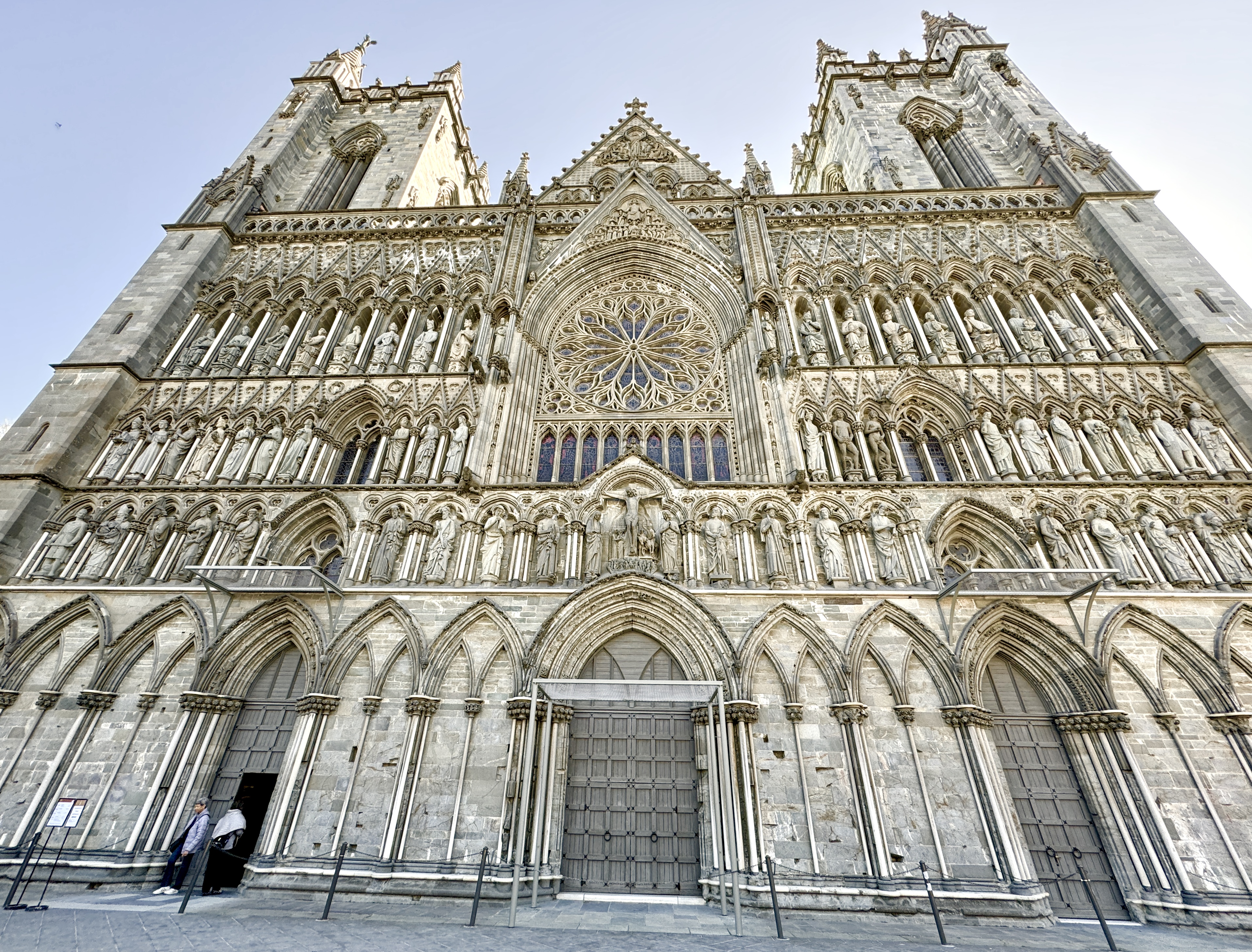
Trondheim, NorwayNidaros Cathedral looms over the centre of Trondheim.

And over the country’s history.

Built atop the grave of St. Olav, between 1070-1300, Nidaros was an important pilgrimage for Northern Europeans during the Middle Ages. For centuries more, kings were crowned within its walls.

This morning, the cathedral's massive rose window sparkles in the sun, a kaleidoscope shimmering from its petals.

Between light and darkness.
As I look up, I'm awed by the the rebuilt west front, which is faced by brownish-grey stonework as intricate as lace. Fifty-seven statues stand like chess pieces, severe countenances etched upon their faces.

In a twist, the one topping the north-west tower is modeled after Bob Dylan

By the nineteenth century, Nidaros was a crumbling shell of itself, having been destroyed by fire, decay and neglect. Restoration continues today.

By all accounts, Trondheim itself is a phoenix

The former national capital has been rebuilt multiple times following massive fires, including one in 1651 that reduced 90 per cent of it to cinders. Today, the wooden wharf of Bakklandet is tinted by the yellows and reds of the bird’s feathers.

Dwarfed.
Throughout Trondheim, bridges seem to serve as braces, holding together a town straddling past and future.

An old crane looms like a steel robot, its hook arm hanging languidly, out of work.

Amidst the buzzing of drills, old shipbuilding yards are fading into condos, hotels and restaurants. Monuments to the town’s nautical history rust alongside dry docks that haven’t been embraced in years. Brick walls have been scrubbed of their pasts.

Trondheim: being born yet again.

Friday, May 17, 2024

Burnt Out.

For whom the bell trolls.
Copenhagen, Denmark – Stepping into Freetown Christiania feels much like peeling away the multiple layers of faded posters affixed to the walls.

The sharp edge of history is still there, but it's mostly buried beneath changing times. 

And and it's vanishing quickly.

Founded by squatters in 1971 as an autonomous hippie commune, Christiania has endured its fair share of troubles, as one might expect from a community predicated on anarchy.

Just last month, the infamous Pusher Street – home to the so-called 'Green Light District,' where illegal drugs were openly sold – was torn up, its cobblestones tucked into the corner of a construction site. A sign tells visitors that violent gangs forced the community to take action.

Skating by.
Soon, a new apartment complex will take its place.

And yet, a definite vibe still twists through the marijuana smoke. 

Mostly, it's a visceral feeling that something is different. Rough buildings and a skate park are made up in bright graffiti. Faded hippies twirl in the grass. Paintings of cameras in red circles still warn you of where you’re actually allowed to take photographs. 

It's hard to imagine anywhere being off-limits now.

Amidst the presumed chaos, there's a hipster coffee shop and several food trucks. An outdoor market sells flowing elephant pants you'd find at any North American music festival. Late-stage capitalism has entered the chat.

It seems anarchy becomes impractical with maturity.

The vibe itself has become an anachronism. Seemingly existing between two states – figuratively and literally – Christinia's time as it was once imagined seems now to have passed. And I'm not sure that's necessarily a bad thing.

But I'm certainly glad I got to see it – and feel it – before the final poster was peeled away and replaced by a shiny glass building.

A Great Dane.

Become a star flyer at Tivoli.
Copenhagen, Denmark – Obscured behind the tall walls of Tivoli Gardens, rides whirl like the flip of a poodle skirt caught in the breeze.

The Star Flyer climbs steadily, twisting as would a spider ascending to the heavens.

At one end stands a mountain of fibreglass, its tip dipped in white. The stiff flag at its peak points to the north. Opened in 1843, Tivoli is the third-oldest amusement park in the world.

The oldest is only 10 minutes away.

Rather than go inside, we sit on a green box edging the sidewalk and eat a pølser wrapped in bacon, painted with remoulade and topped with a sprinkle of crispy onions. It’s the extent of our carnival today.

But it’s a (very) good one. Even the late Anthony Bourdain raved. Yes, about a hotdog.

Anyone have a corkscrew?

So I sit with shoulders shrugged, hopeful the sunshine will erase the grogginess that comes with having been plied into an airplane seat that doubles as a straitjacket. It has been a long day of travel and we’re hanging on by an eyelash for our limited time in Copenhagen.

The only clouds are in my head, but exhaustion still feels like wool, tucked above my temples.

It’s a national holiday in Denmark and others obviously feel better than we do. For Constitution Day, they walk along the various canals, well-dressed in white with Danish flag ribbons stuck to their chests. 

Many swing open bottles of wine.

Although we typically walk everywhere, we maximize the value of our 24-hour transit passes by taking water taxis around the city, including to the Little Mermaid and the lesser-known Genetically Modified Little Mermaid. Flags rattle against silent masts, pinned to the harbour. 

Nyhavn: a box of crayons.
We pass long lines of people tanning casually along the shore and among Nyhavn's wood and plaster structures, which groove in shifts of bright colours. Most are more than 350 years old. 

Sunlight offers a bright, white exclamation mark that cascades on indifferent ripples in the water.

Turning the corner, a small boat pops out from under a shallow bridge, a table set at its centre. A bottle of wine stands sentry.

I could get used to this.

Sunday, December 17, 2023

Kicking Back.

This show has legs.
New York City, New York – Music builds in concert with the orchestra rising from the cavernous Radio City Music Hall stage.

It's an apparition with woodwinds.

Then, percussion as dancers tap in unison, microphones tucked into their shoes. Dressed as reindeer, revellers and wooden soldiers, they twirl and kick like ribbons of colour, rhythmic in the breeze.

Santa Claus slides in on a sleigh before multiplying in a chorus of "ho ho hos." A young boy's eyes grow wide at the appearance of 40 more, each popping up in spotlights around the theatre.

More than 1,100 costumes and pairs of shoes are used in the Rockettes Christmas Spectacular.

A very New York City holiday experience.
While much of the show hasn't changed since its debut in 1933, some immersive elements now require 3D glasses. More than a million pairs are handed out each year.

Drones flutter through the auditorium like fairies and pyrotechnics bring the performance to a close with a bang. With 160 synchronized high kicks each show, you'd have thought there would already be enough entertainment.

In the last scene, the stage grows dark and becomes serious. No more colourful helpers making toys.

Real sheep, donkeys and a camel trot slowly across the stage, drawing a line to the nativity scene. It may be the reason for the season, but it's a drastic shift in tone from the rest of the show.

Santa must have needed a break.

Saturday, December 16, 2023

Parked.

New York City, New York – Aromas of baked goods and cheese dance in the air as raclette melts, twisting off the blade and onto a baguette.

Ice skaters twirl in parallel.

Frankly, it's a nice respite from the smells of weed and booze that seem to permeate the city.

Set up like chess pieces, the green-framed huts in the Bryant Park Winter Village serve as magnets for holiday crowds by offering crafts, gifts and food of all varieties. Passers-by tug on cups of hot chocolate so thick one merchant advertises that chewing isn't allowed; another twists freshly boiled pasta into a 70-pound wheel of Parmesan.

Jostled by endless lines of people, I feel the same.

But the sun twinkles on the tall Christmas tree and off the skyscrapers surrounding Bryant Park, whose revitalization over the past couple decades has allowed it to shed its previous "Needle Park" moniker. It now breathes a European flair into the city.

We trace the grid back up to Broadway, where we see Hamilton at the Richard Rogers Theatre, which has housed more Tony Award-winning Best Plays and Best Musicals than anywhere else. As expected, the show is great, but the theatre is cold, cramped and today has only one operational restroom. 

Patrons aren't thrilled.

But a post-show visit to New York landmark Junior's takes the (cheese) cake.

Sunday, July 16, 2023

Tough to Articulate.

"Man Hanging out," David Černý.

Prague, CzechiaFranz Kafka's head spins gently, in silvery tranches.

Modern buildings are distorted in its mirrors.

A man and a woman hang from umbrellas over the street; Einstein, from a beam. A Russian tank, currently painted the colours of the Ukrainian flag, is half buried in a lawn.

Nearby, ghost-like men emerge from the trees, haunted and crippled. The memorial to victims of communism still bears scars of an explosion.

Re-reading my notes from the past couple days, I can see how the heat and my exhaustion haven't served me well in the crowds. I'm not here for the parties, and the crassness of it all likely tainted my initial impressions.

So far, Sunday morning seems quieter.

I'm still grateful for the opportunity to experience such a historic and global city – there's so much beauty to see, but many of the unfortunate parts of capitalism are on full display.

But I have absolutely loved all the public art.

Saturday, July 15, 2023

Tagged.

Definitely not to be confused with Lenin.
Prague, Czechia – A pair of granny glasses peers atop a spaghetti bowl of crayon scribbles and a collage of stickers from around the world.

They're instantly recognizable.

The top half of a face is the only remaining reference to John Lennon on the Lennon Wall, which now bears enough coats to weather a thousand winters. Painted and repainted with messages of activism and peace since the 1960s, the wall has undergone a constant metamorphosis and included tributes to Lennon since his murder in 1980.

Now, it largely resembles any tunnel leading into a train station.

Culture continues to evolve, and tomorrow's wall is a box yet unopened.

But I can't help but feel Lennon's obscured eyes, roughly tattooed by people's names, offer a quick peek into modern culture where, for many, the collective struggle has been replaced by relative individual comfort.

And by selfies.

Friday, July 14, 2023

Stumbling Blocks.

Prague, Czechia – Taking an evening stroll, I trace tic-tac-toe boards of grey and white cobblestones.

Squares give way to crosses, then to diamonds and stars.

Three brass squares shimmer like gold teeth in the day's shrugging light. 

Inscribed with names of the building's former inhabitants, they're among 400 stumbling stones in the city – and 75,000 across Europe – commemorating individuals removed by the Nazis, never to return.

The stones are part of a decentralized Holocaust memorial that's not without controversy. But tonight, nobody else seems to take the time to look up or down.

There's another bar to visit.

Wednesday, October 19, 2022

Unfollowed.

Tokyo, Japan — We were treated to a generous, yet extremely rushed visit to the Miraikan National Museum of Emerging Science and Innovation this morning.

I was particularly struck by the Mission Survival: 10 billion exhibit, which includes a massive shake table that launches marbles of various sizes into the city to demonstrate the vast impact of various threats to our survival. Even with the doom and gloom, it's science communication at its finest.

This, however, will forever haunt my dreams.


Sunday, February 18, 2018

Wednesday, December 13, 2017

Hola, NOLA.

Dancing in the streets.
New Orleans, LA – “Braaap!

We’re greeted by blasts of brass horn and a storm of powdered sugar as we arrive in the French Quarter.

It turns out visiting the famous Café du Monde offers a far different whiteout from what we experienced during yesterday’s drive. Tables and chairs are slicked by remnants of confectioners’ sugar peaked onto still-warm beignets and subsequently caught on the breeze.

Fattened crows, pecking at the ground of the outdoor café, are thrilled.

Stepping into the elegant Omni Royal Orleans is like stepping into history, as is anywhere in the French Quarter, where ornate iron railings and wrap-around balconies frame art galleries and bars – lots of bars. These days, it seems some of this history has been perverted by neon and cheap Chinese trinkets, but beauty lies behind the troubling evidence of rampant addiction and homelessness.

On cue(s), a man staggers by as if he has wooden legs. It's still early.

But, N’awlins is known for its soul, expressed through food, art and music.

VooDoo like to come in?
Brass bands fill the squares, kept in tune by the rat-a-tat-tat of snares, as we tuck into the back of the Erin Rose and into a one-table room with the trappings of many years of bartending: an old Miller High Life sign rests in a retired brick fireplace. Something tells me it’s not the only thing lit in here.

But the grilled shrimp po’ boy sold under the flag of Killer Po’ Boys – logo: skull and crossed baguettes – is tremendous.

Later, neon catches fire as we wander down Bourbon Street, and into the famed Carousel Bar, which installed an operational merry-go-round in 1949. At least I can blame the rotating bar seats for my world spinning.

The stars, meanwhile, have been replaced by the twinkle of tiny white Christmas lights wound through the trees and over the balconies. One is festooned with "Peace, Y'all."

In the distance, a trumpet sounds mournfully.