Tuesday, May 10, 2011

Magic.

Titus, DC and Bobo during one of the welcoming dances.
Chekalini, Kenya – A long but beautiful day on the road has carried us to the most incredible of nights.

After wending our way over the clay arteries that lie beyond Eldoret, we arrived at Eric's family's home in Chekalini this evening. We were immediately greeted by a welcoming committee that framed the front of the house.

Eric dissolved into his mother's eagerly awaiting arms as we shook hands with his brothers and sisters, and high-fived the numerous nieces and nephews. There may have been a few tears.

We entered the house and were blessed with a traditional prayer of welcome and offered a meal. All day, the children had made excuses to stay home from school in case we arrived, conveniently forgetting their pencil cases or their homework. There may have been some excitement.

Initially, the children eyed the large white man I am with a degree of suspicion. Then I showed them just how poorly I dance.

Soon, they mimicked every shake of my arms and awkward rattle of my hips as everyone laughed and clapped along. Consider the ice broken. I soon taught them the 'exploding fist bump,' several new ways to contort one's face and "I've got my eye on you," replete with hand gestures.

They gobbled it up.

The children sang us songs in Kiswahili and English, and I showed Lincoln (Bobo) how to take photographs. He insisted on using the viewfinder, rather than the giant screen on the back. Whatever works. Then he and Titus reached up and took my hands to guide me on a tour of the property. It was pitch black, though the night sky was perforated with diamonds.

"Twende," they said as we wove through the dark pasture. There may not have been much we could actually see, but their pride in their home shone through.

Tonight was magical.

Quite a Rift.

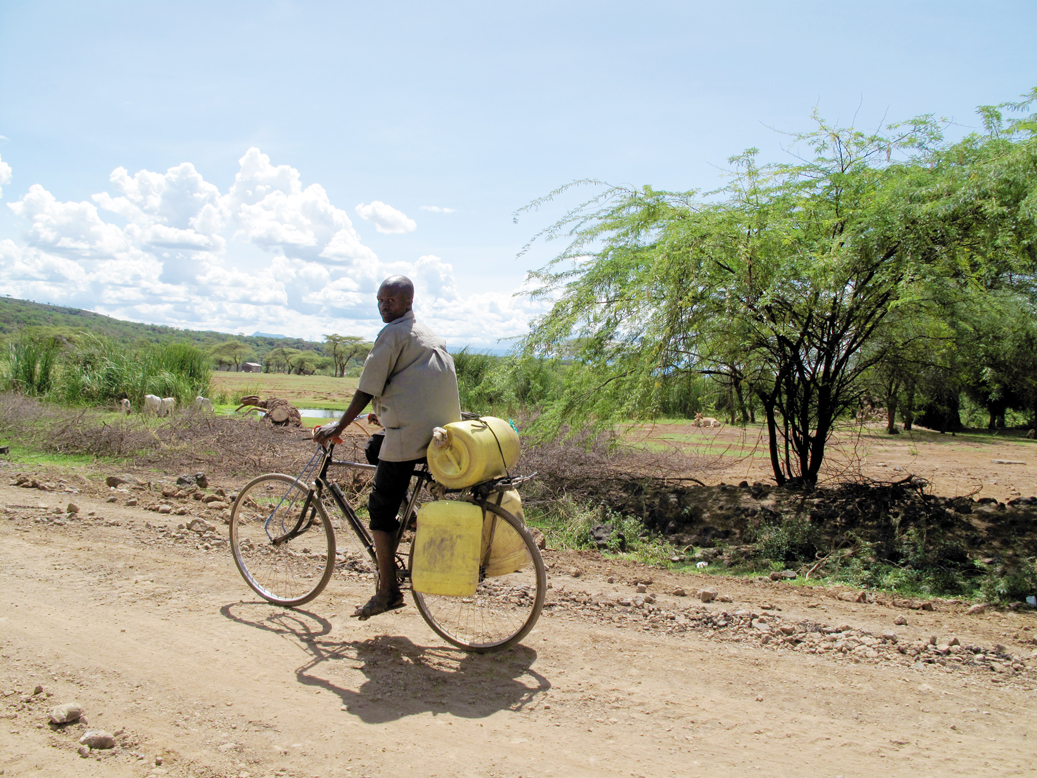
A man rides his bicycle through the Rift Valley.
Chekalini, Kenya – As we coursed along its tongue, the cavernous jaw of the Rift Valley appeared to swallow us, its pebbly walls rising as we wound down serpentine switchbacks into dry pastures of scrub and stretching acacia.

Cacti lined the road, standing sentinel with spiny paddles.

The road at the head of the valley, which leads to former President Daniel arap Moi's home region, is well-paved, but silent. As so few vehicles pass by, locals quip it is best known as a resting place for goats and cows.

Sure enough, around the corner lay a goat, nonplussed, chewing on a long blade of grass.

Crossing the equator and descending farther, however, we rattled across pocked roads as the ground blushed with the red of clay, its lips whispering small puffs of dust. Termite hills as tall as I rose from the landscape like stovepipe hats.

Yet, even as the sun threw blazing rays earthward, motorcyclists remained bundled in down coats – the concept of heat obviously dependent on the climate to which one is accustomed. The whole way, we waved at wide-eyed children in school uniforms who double-took at the palour of our skin.

Toward the end of the day, rain set a local market into motion as tarps were drawn like curtains over stick-framed kiosks selling everything from shoes, to fruit, to suitcases. Weather had signaled the end of the show.

We had been on the road for nearly 12 hours, setting out from Lake Naivasha to see the splendour of the Great Rift Valley and to visit Eric's family in the Western Kenya village of Chekalini.

With a thud in Eldoret, though, we heard the now-familiar snake-like hissing and, for the second day in a row, were roadside – covered in ochre – changing a punctured tire.

This is becoming a habit.

Monday, May 9, 2011

An Abridged Version.

Giraffes watch us as we spin out, stuck on a hill.
Lake Naivasha, Kenya – As dusk settled in like a smudge of heavy eyeshadow, a curious giraffe elongated its neck toward us at the side of the road.

It was close enough we could see its eyelashes, batting like fans.

Despite the pacifist nature of our newfound friend, this was not the best time of day to be stranded in a field of wild African animals.


No, ever-dangerous hippopotamus would soon begin stretching from a day spent staying cool in the water, and foraging with mouths studded by tusk-like teeth. Despite being herbivores, they can be indiscriminate in their violence.

And yet, there we were, tipped sideways in the car, hanging precipitously over the edge of a hill in the riparian area behind the house, the vehicle's belly grounded against a crumbling stone bridge. As we tried to lift the vehicle back onto the road, the tires spun, cloaking us in a cloud of vaporized rubber.

It would not budge.

Yup, we were pretty stuck.
We had already had to change a punctured tire on a dusty hill in Karagite earlier in the day – an event that had attracted other curious onlookers as we attempted to loosen bolts in the middle of a roughly hewn, angular road, amidst homes fabricated of mud and sticks.

With a series of guttural cries, we wedged our hands under the front bumper and tried to raise the vehicle onto the dirt path. By mistakenly spreading the fingers of my right hand onto the spinning tire, I soon learned the car was front-wheel drive.

And I wondered if my now-erased prints would qualify me for a future career in the secret service.

Standing in a bush of thorns, we repeatedly heaved the car upward while awkwardly leveraging ourselves against the side of the hill. Still, the car teetered and we remained fearful it would roll down the hill – on top of us, no less. With the help of a couple locals, though, we eventually wedged a large chunk of the bridge that had become dislodged under the tire.

Traction. At last.

Nonplussed, the giraffe continued snacking on its live salad of nettles as we pulled out through a growing number of wildebeest, zebra and waterbuck.

Friday, May 6, 2011

I'm on a Boat.

Hungry, hungry hippos, looking for the marble.
Lake Naivasha, Kenya – Hippos cloaked by papyrus snorted like pigs with megaphones and leapt toward the boat with a seismic splash.

Our captain had backed into the area for this very reason.

With a quick crank of the throttle, the nose of our boat lifted from the water and pulled free of the reeds, which it spat into the air like confetti.

Nearby, three families of hippopotamus lay submerged, their eyebrows shrugging and nostrils flaring as they loudly sprayed water in disgust. Fish eagles swooped by with curved swords extended, plucking fish from the lake with a cry as piercing as their talons, before climbing back into the trees.

I was touring the lake with Western’s Ecosystem Health – Africa Initiative, where we conducted interviews to better understand the relationship between the growing community, the billion-dollar flower industry and the health of both individuals and the ecosystem.

Up one hill lays a sprawling, unplanned village without a sanitation program. Its refuse ends up in the lake. The entire slum works for one specific rose grower in the region and, in direct contrast, the owner lives in a white, castle-like home a farther up the lake. These manufactured communities provide their own schooling, healthcare, housing and daycare for employees.

The industry is big business, employing a quarter of the 450,000 residents around the lake, many of whom came to the area during the 1990s when the population was only 20,000. The environmental impact of both human migration and from the flower businesses has been tremendous on Lake Naivasha.

As one local described it: “The flower companies are the mother of Naivasha – a cruel mother.”

Thursday, May 5, 2011

In the Backyard.

Dark meat or white meat?
Lake Naivasha, Kenya – Pulling up to our quaint cottage nestled under a trestle of acacia trees, we agreed to stretch our legs after the drive and to take a walk into the field behind us.

Lake Naivasha sprawled below.

Birds chirped against a verdant backdrop that soon exposed dark shapes that moved in herds. Both the house and land surrounding it provided the setting for the 1966 movie, Living Free.

Throaty thunder rolled percussively in symphony with wildebeest hooves parading across the open space.

We walked through constant reminders of the very real presence of Africa’s wildlife, past thorny trees and dry soil littered with the bleached vertebrae of a giraffe, fallen like dominoes and spread as long as its neck was in life. Nearby lay a zebra with hollow eyes and an empty belly.

It was no longer hungry.

To the side, wildebeest banged heads and waterbuck eyed us cautiously. A brown-striped baby zebra galloped beside its mother as a trio of giraffe loped away like teenagers with an awkward gait. Turning to look back at us, they dwarfed the herd of tan antelope with feminine features underfoot.

This is our backyard.

Fuelling Adventure.

Creative means for fuelling a car.
Nairobi, Kenya – After five hours spent waiting for our vehicle to arrive, the orange fuel light menaced us with a winking eye.

Choking on the few fumes remaining in its tank, the large van carrying us to Lake Naivasha would soon be left breathless from the standstill traffic. We looked for a modern-day Moses.

The fuel shortage is currently so serious in Nairobi that people queue on foot for hours, clutching jerry cans even as they stand in suits. Despite the lack of petrol, traffic is chaos as an increasing number of vehicles creep through belching clouds of exhaust.

It takes hours to get anywhere.

Radio chatter alerts listeners to gas stations that have received a new supply, which leads to an immediate rush to the pumps. Soon thereafter, yellow tape is pulled across the tanks like a curtain signalling the end of a show.

As the day’s heat rose, we found a barren station where we could siphon gas from the smaller car we had previously rented, and watched the attendant empty it into a large green garbage can. Using an old plastic oil jug as a scoop and a water bottle fitted with a rubber tube, he cautiously fed the precious fuel into the tank’s gaping maw.

With its thirst quenched, the engine sparked to life and the fuel gauge slowly tilted east, even as we headed northwest through the Rift Valley, looking over Longonot Crater and onto Lake Naivasha, which is ringed by the shiny tarps of flower production.

Hamna shida: after yet another hour, we were back on track.

Wednesday, May 4, 2011

Marketing.

Vendors hawk their wares at the Maasai market.
Nairobi, Kenya – A muted brown field hosts the weekly open air Maasai market in Nairobi, and it seemed to be transformed into a tulip farm by all the brightly coloured goods for sale yesterday.

If only it smelled as good.

Sitting on grey tarps covered with wood and stone carvings, beaded jewellery and toys, blankets and paintings that repeated themselves from shop to shop, women constantly implored us to check out their wares. Maasai sat draped in traditional beads, their stretched ear lobes grazing their narrow shoulders. Gnarled fingers became artfully entwined in wires-full of beads, dancing as they crafted ornate neck pieces.

If the vibrant colours were not enough to make you think your brain had been inserted into a kaleidoscope, the sheer hustle and bustle may have.

And hustle they did.

Before so much as entering the market, we had already made many new ‘friends’ who promised to guide us around and help us make a deal. I soon had three, who placed items in which I had expressed a mild interest into a shopping bag. “These are ‘the maybes,’ we call them,” one said.

They were very friendly, but tenacious. Shopkeepers called over: “promote something of mine – buy something, even small.” Word of our presence spread quickly and everyone always seemed to be aware of where we were, what we had looked at and what we might be interested in. This, despite the size and commotion of the market. One salesperson even came up to me and said I worked in communications.

I had not told anyone.

Colourful fabrics hang in the Maasai market.
Having finished stepping through the labyrinthine path that divided the tarps, my new friends spread my wares onto the grass and began to negotiate, writing the numbers 1-4 on a piece of paper. This was where we were to respond to each other’s pricing salvos. The larger of the men placed 16,000 KSH beside number one.

For a half hour, we shared back pats, laughs, jokes and conversations about our families. Numbers and conversion rates turned to slurry in my mind.

I negotiated down to 14,500 KSH before giving him 2,000 KSH and asking for change. I had not converted correctly in my head and I soon realized the extra zero I had overlooked made for a ridiculous price. I walked away anew, saying we were not even close enough to begin a negotiation.

“Name your price, my friend,” he said. “You’ll be insulted,” I replied. “Insult me,” he added with a big smile. The game was back on.

I felt no pressure because I did not need any of the gifts I was purchasing and I have plenty of time to pick something up – outside the city where prices are generally lower, no less.

Sensing a deal slip away as I inched closer to people I knew who had finished their shopping, one of the salesmen left, frustrated. His two colleagues did not give up so easily. They kept at it, taking turns, and eventually offering 3,500 KSH – even trying to play to my emotions. “I have five children and two wives, and I haven’t eaten today,” one said.

I decided I would not budge from 2,400 KSH and held strong until we finally agreed for 100 shillings more – minus a necklace of trade beads they said they wouldn’t even take less than $50 for on its own.

While I may have still paid mzungu prices, I was comfortable both with my purchases and with supporting the local economy. It was exhausting, and while I do not tend to enjoy haggling, it remains a central aspect of the culture here. This time I even had fun with it.

“You are a hard bargainer,” one said before shaking my hand goodbye, his eye already tilted toward his next mark.